
What a Synthetic Caller Can and Cannot Establish

Shashank Agarwal
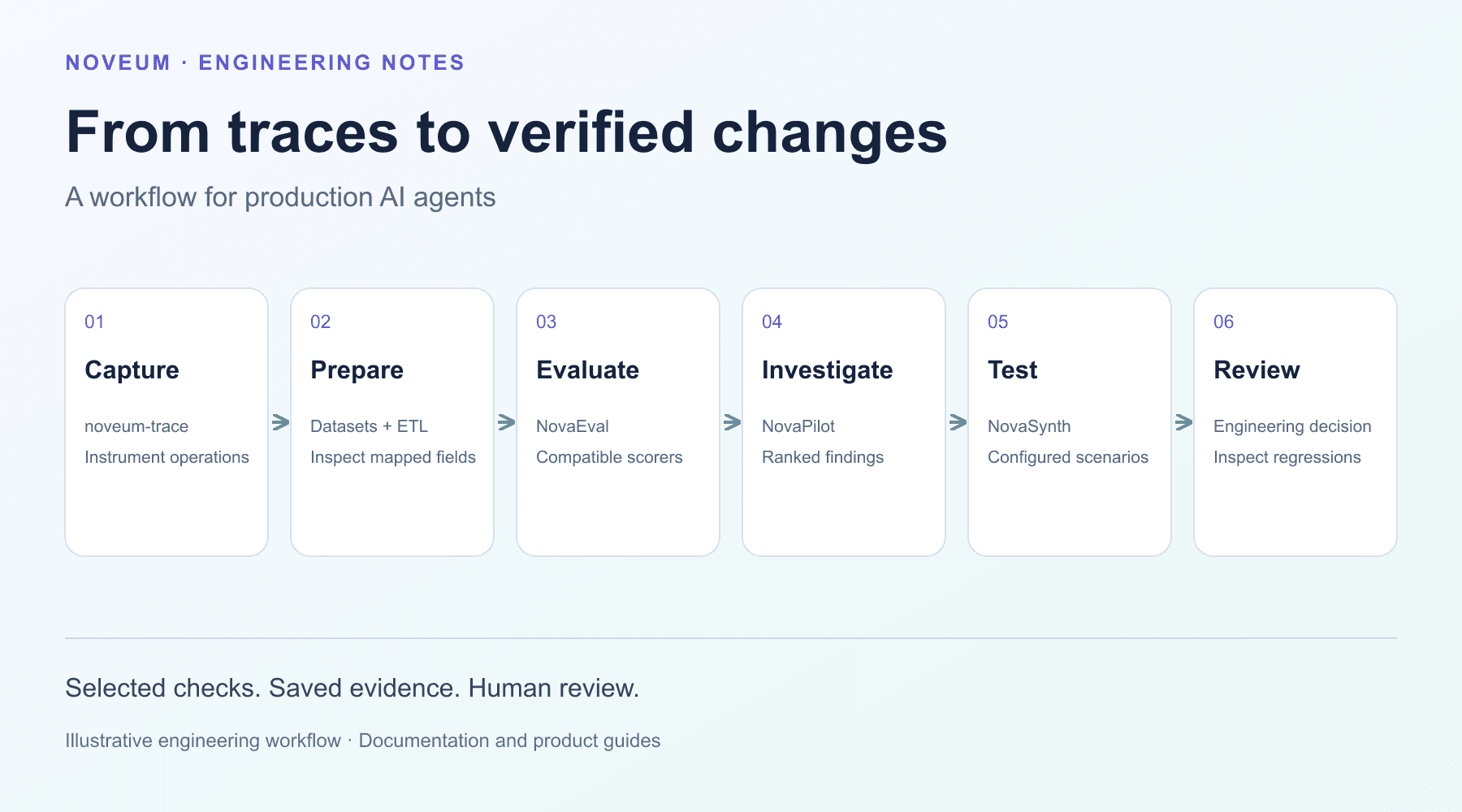
A synthetic caller is a test participant built from a configuration. It can exercise a useful scenario without establishing how every real customer will behave. Keeping that boundary clear makes the results more useful.
Quick answer: Use synthetic calls to test defined tasks and failure conditions under recorded settings. Report the scenarios and evidence actually exercised. Treat results as evidence about that test setup, then combine them with appropriate production observations and human review before making broader claims.
State what the run represents
For an illustrative support scenario, the caller might seek a replacement delivery date, become impatient after a repeated question and reject an unavailable option. That configuration can probe a concrete behavior.
It does not establish the frequency of that behavior in the customer population. A deliberately difficult scenario set is useful for finding weaknesses, but its failure rate is not automatically a production incident rate.
Separate coverage from realism
| Observation | Conclusion it supports |
|---|---|
| A configured interruption occurred | That event was exercised under the recorded setup |
| The agent recovered in the run | The captured behavior met the defined recovery check |
| A synthetic caller expressed satisfaction | The simulator produced that response |
| A backend fixture reached the expected state | The test’s observable task condition was met |
| A case was never exercised | No result for that condition has been established |
A simulated satisfaction statement is not a real customer survey. A realistic voice is not proof that the scenario distribution matches production traffic.
Validate the test participant too
Inspect whether the caller followed its own constraints. Did it reveal information it was not supposed to know? Did it accept a proposal the scenario required it to challenge? Did an early disconnect prevent the intended branch from being exercised?
Those conditions affect what the run can establish about the target agent. Preserve them rather than blaming every failure on the agent under test.
Connect rehearsal to operating evidence
Use reviewed production failures to suggest new cases where appropriate, with suitable data minimization. Keep the synthetic reconstruction distinct from the original event. After a candidate change, inspect representative evidence from the deployed application rather than assuming rehearsal guarantees production improvement.
I’m Shashank Agarwal, founder and CEO of Noveum AI and creator of API.market. NovaSynth is intended for configured synthetic-user testing. This article describes how I recommend interpreting such evidence; it reports no measured customer result.
The eval-driven guide covers iteration, and the monitoring guide covers the deployed evidence workflow.
Follow my work on LinkedIn. Drafted with AI assistance.
Get Early Access to Noveum.ai Platform
Join the select group of AI teams optimizing their models with our data-driven platform. We're onboarding users in limited batches to ensure a premium experience.