
What to Capture at an Agent Tool Boundary

Shashank Agarwal
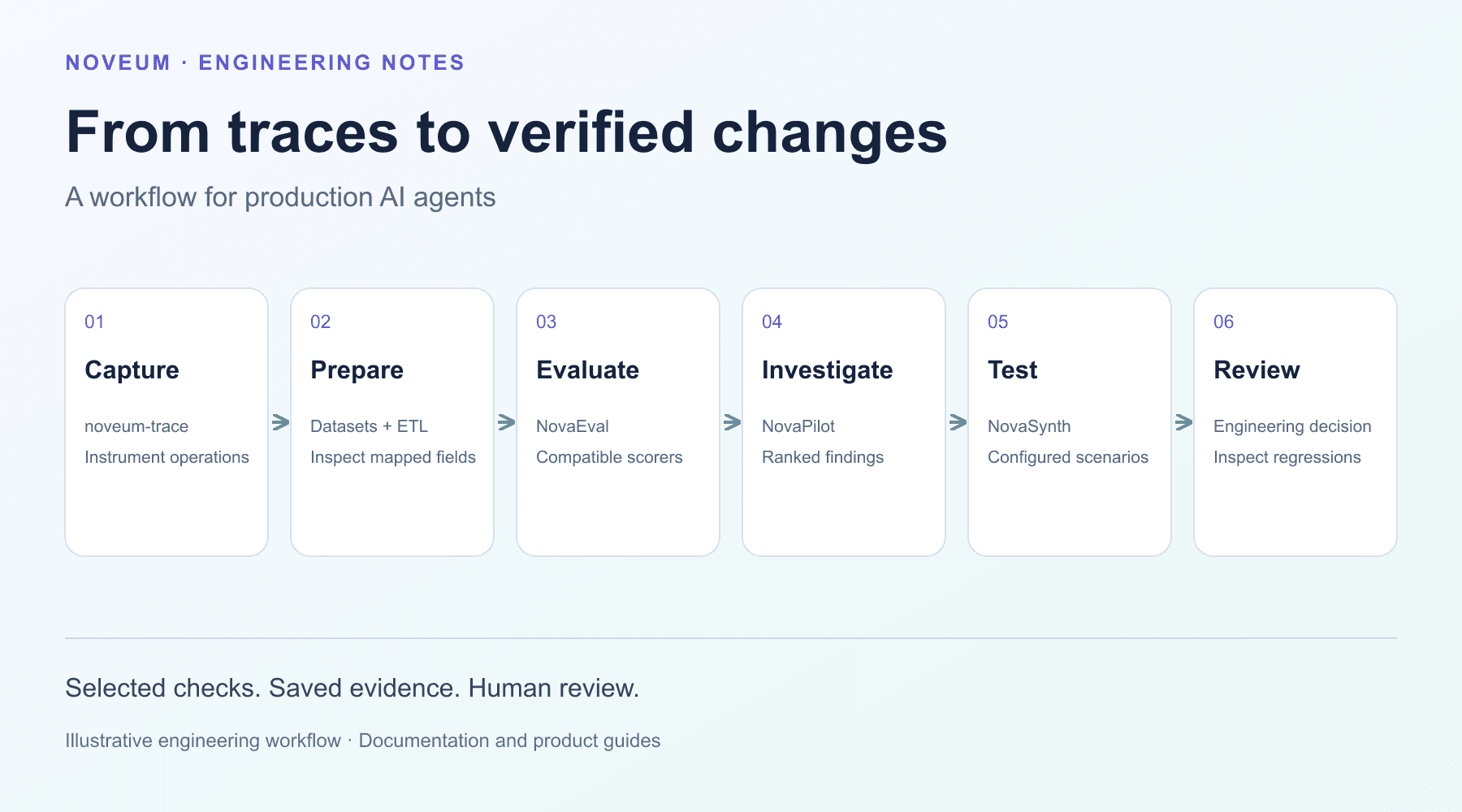
A tool boundary is where an agent’s intent becomes an operation against another system. Recording the right evidence there can make a later failure understandable without collecting every payload indiscriminately.
Quick answer: Capture the operation identity, appropriate input references, relevant result state, error condition, timing and application configuration needed to interpret the call. Distinguish a proposed action from an executed action and a returned response from the downstream state change. Minimize sensitive fields deliberately.
Start from the investigation question
For an illustrative document-export tool, a reviewer may need to know which document was requested, which format was selected, whether permission was present and whether a usable file was produced.
The full document body may be unnecessary for that question. A safe identifier, version, format and artifact reference may provide better evidence. The right fields depend on the task and data-handling requirements.
| Field | Question it helps answer |
|---|---|
| Operation and tool version | Which interface was used? |
| Request or trace identifier | Which surrounding task does it belong to? |
| Appropriate input references | Was the intended entity selected? |
| Permission evidence reference | What authorized the operation? |
| Result state and artifact reference | Was an output actually produced? |
| Error and timing | Where did the operation fail or stall? |
| Configuration version | Which behavior and settings were active? |
This is a proposed record structure, not a universal SDK schema.
Separate the stages of an action
A planned call is not an executed call. An accepted export request is not necessarily a finished file. A file reference is not proof that the content meets the task.
Record the stage that the evidence actually establishes. If an operation is asynchronous, retain the relationship between its request and completion evidence. Do not mark success solely because the agent wrote a confident final message.
OpenTelemetry’s trace concepts explain operations represented by spans and their relationships. Your instrumentation still determines which application-specific fields become available.
Keep diagnostic and sensitive information separate
Record a useful error type without automatically copying credentials, full customer content or signed download URLs into broadly accessible logs. Review retention and access for the evidence store itself.
When data is omitted, preserve enough context to explain the omission and the check’s resulting limits. A missing required field should produce a coverage gap, not an inferred pass.
Verify one representative call
Inspect a successful export, a rejected request, an unavailable document and a completion failure. Confirm that the records distinguish those states and link to the correct task. Test the evidence path before depending on it during an incident.
I’m Shashank Agarwal, founder and CEO of Noveum AI and creator of API.market. The workflow walkthrough connects captured operations to evaluation items, and the monitoring guide covers investigation and review.
Follow my work on LinkedIn. Drafted with AI assistance.
Get Early Access to Noveum.ai Platform
Join the select group of AI teams optimizing their models with our data-driven platform. We're onboarding users in limited batches to ensure a premium experience.