
How to Catch AI Agent Failures Before Your Users Do: Building a Pre-Deployment AI Agent Evaluation Gate

Pragati Tripathi
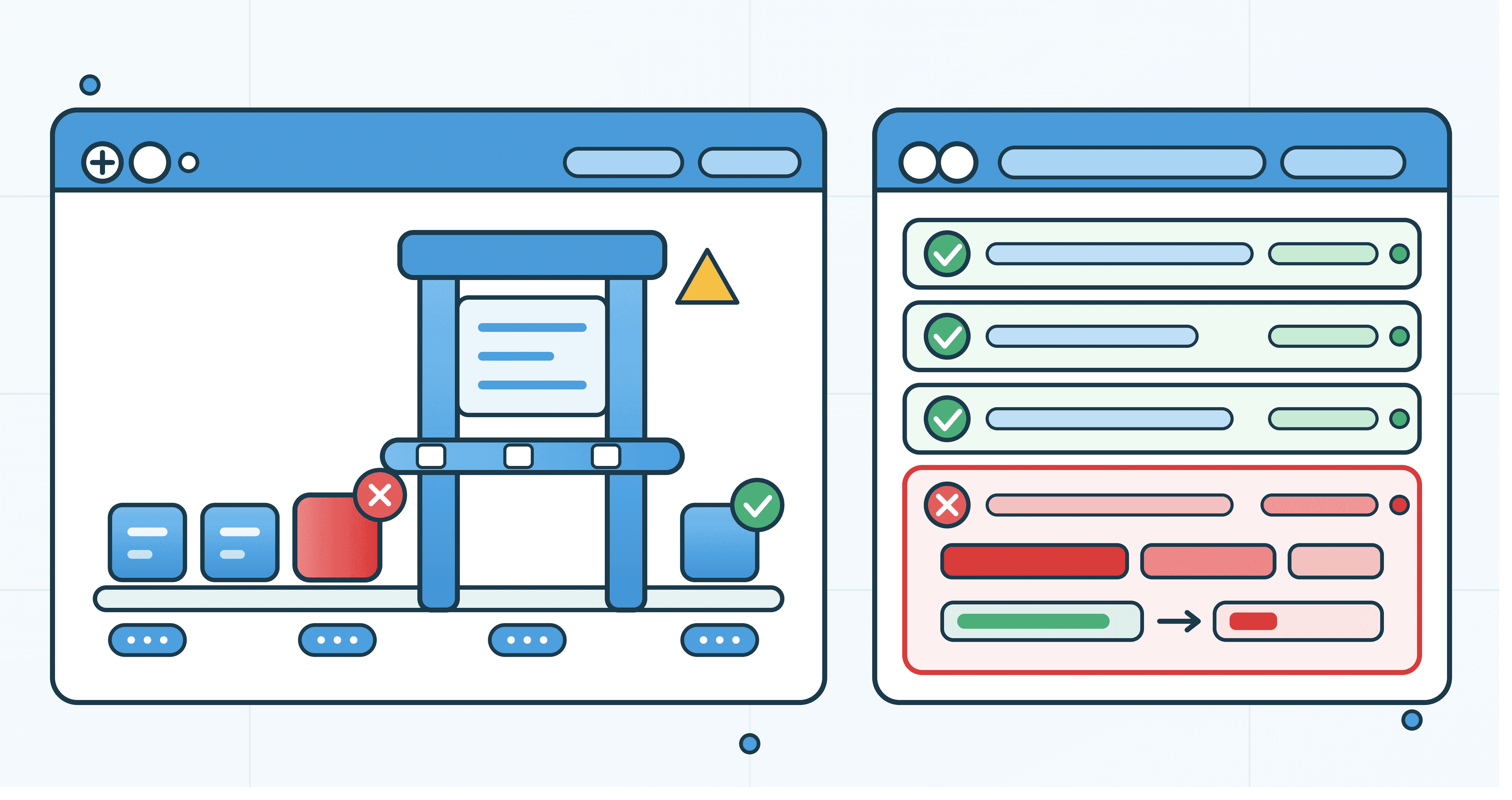
Your latest agent update fixed three customer issues. It also increased response latency, missed a few edge-case tool calls, and dropped instruction adherence on a handful of conversations. None of those regressions looked serious enough to block the release, so the deployment went ahead.
A week later, support tickets tell a different story. Customers aren't complaining about the issues your team expected. They're abandoning calls because the agent hesitates before speaking, asking the same question twice in long conversations, or silently skipping a tool in situations your happy-path tests never covered.
An AI agent evaluation gate exists to answer one question: which of those regressions should have blocked the release? Most teams don't ship agents without testing. They ship knowing there are imperfections, but without a reliable way to tell an acceptable regression from a production blocker.
What is an AI agent evaluation gate?
An AI agent evaluation gate is an automated check that runs your agent against a fixed set of test cases before a change reaches production, scores each response across the quality dimensions that matter, and blocks the release when any dimension falls below a set threshold. It sits in the same place a unit-test suite sits in CI, but instead of asserting exact outputs it measures whether the agent stayed grounded, called the right tools, held its role, and stayed safe. It turns "the code compiles" into "the agent behaves." It also turns a release debate into a pass/fail decision the whole team can read.
AI agents rarely fail the same way twice, and fixing one behavior often changes another. A prompt update that improves retrieval can reduce instruction adherence; a faster model can smooth latency but introduce new hallucinations.
The goal isn't to have zero failures before deployment. It's knowing which regressions are acceptable, which are expected, and which block the release. That is the job of a pre-deployment evaluation gate.
Five ways an AI agent fails silently, and the check that catches each one
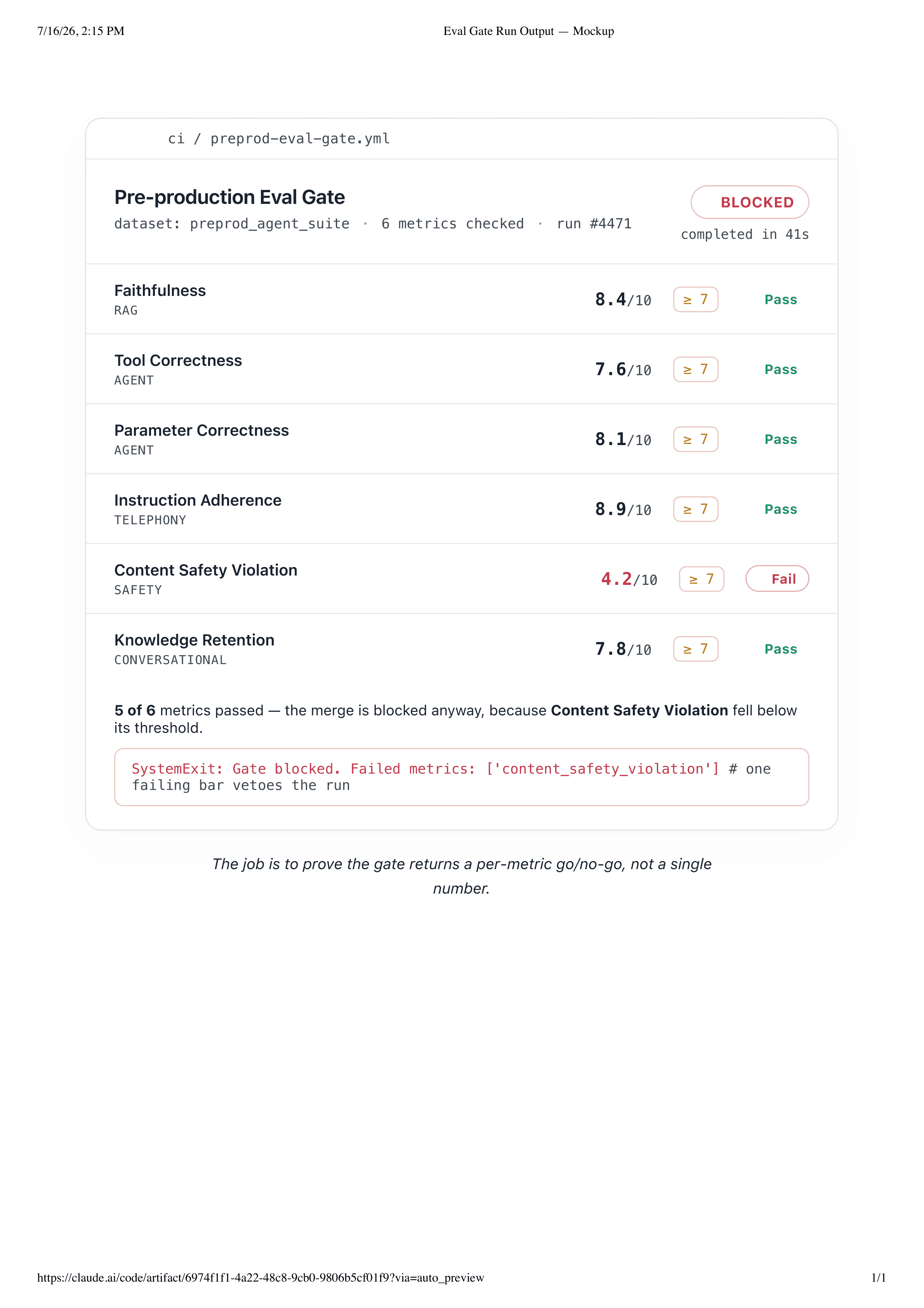
A standard unit test won't catch any of these: the function still returns a string, the assertion still passes, and the failure ships anyway. The code ran correctly; the agent's reasoning didn't. Closing that gap means gating on named failure modes, each scored and thresholded independently, never averaged into one pass rate. A blended 90% can bury the one failure that actually mattered.
-
Hallucination. The agent states a fact absent from the retrieved context or tool output, and the answer still parses as valid. Caught by a faithfulness check: does every claim trace back to context or a tool result? Blocked independently if the score drops below baseline.
-
Wrong tool use. The agent answers from memory instead of calling the right tool, calls the wrong one, or calls the right one with bad parameters (a malformed date, a swapped customer ID). Caught by tool correctness, scored as two separate numbers (tool selection and parameter accuracy), because an agent can pick
refund_ordercorrectly and still pass the wrong amount. -
Role or policy drift. The agent breaks character, skips a required disclosure, or gives advice it was told to refuse. Caught by role and instruction adherence, a hard gate on any regulated or scripted flow, not a nice-to-have.
-
Unsafe or disallowed output. A response crosses a policy line: harmful advice, disallowed or toxic content. Caught by safety and moderation checks, where a single violation blocks the build on its own, regardless of every other score.
-
Context loss across turns. By turn six, the agent has forgotten what the user said in turn two, and asks again. Caught by context retention, tested across a multi-turn scenario, since a single-turn test structurally cannot detect this.
Each check exists because a specific failure sits on the other side of it. That's the difference between an evaluation gate and a quality score. A gate built this way, the pattern Noveum's scorers are designed around, blocks five named ways an agent breaks instead of returning one abstract number that hides which one just happened.
Build your AI agent evaluation gate in four steps
Start with a test set that covers the cases you have already seen fail plus the ones you have not. Pull real failing conversations from production traces, and generate synthetic edge cases for the paths that rarely appear in normal traffic: the adversarial user, the ambiguous request, the turn-seven context switch. Synthetic coverage is what closes the staging-to-production gap. It stops the gate from only defending against last month's bug. Noveum's NovaSynth builds these scenarios from personas, so the gate tests inputs your production logs never contain.
Next, wire scorers to each dimension and run them in CI on every pull request. That is continuous evaluation of your agent, triggered by the same event that runs your unit tests. Noveum's Eval Jobs API lets you register a set of scorers against a dataset once, each with its own threshold, then trigger that same check from your pipeline.
The pattern below is illustrative. Confirm the exact response shape against the current API reference before you wire it into CI.
import os
import time

import requests

NOVEUM_API = "https://api.noveum.ai/api/v1"
NOVEUM_API_KEY = os.environ["NOVEUM_API_KEY"]
HEADERS = {"Authorization": f"Bearer {NOVEUM_API_KEY}"}

# One eval job, set up once, holds the dataset plus every scorer's own threshold.
# The request body takes a list of scorer configs, not a single score.
SCORER_CONFIGS = [
    {
        "scorerId": "faithfulness_scorer",
        "scorerName": "faithfulness",
        "scorerType": "rag",
        "threshold": 7,
    },
    {
        "scorerId": "tool_correctness_scorer",
        "scorerName": "tool_correctness",
        "scorerType": "agent",
        "threshold": 7,
    },
    {
        "scorerId": "parameter_correctness_scorer",
        "scorerName": "parameter_correctness",
        "scorerType": "agent",
        "threshold": 7,
    },
    {
        "scorerId": "instruction_adherence_scorer",
        "scorerName": "instruction_adherence",
        "scorerType": "conversational",
        "threshold": 7,
    },
    {
        "scorerId": "content_safety_violation_scorer",
        "scorerName": "content_safety_violation",
        "scorerType": "safety",
        "threshold": 7,
    },
    {
        "scorerId": "knowledge_retention_scorer",
        "scorerName": "knowledge_retention",
        "scorerType": "conversational",
        "threshold": 7,
    },
]


def run_gate(eval_job_id: str) -> tuple[bool, list[str]]:
    """Trigger the eval job, wait for it to finish, report per-metric pass/fail."""
    requests.post(
        f"{NOVEUM_API}/eval-jobs/{eval_job_id}/trigger",
        headers=HEADERS,
        json={"scorerConfigs": SCORER_CONFIGS, "forceReevaluate": True},
    ).raise_for_status()

    while True:
        status = requests.get(
            f"{NOVEUM_API}/eval-jobs/{eval_job_id}/status",
            headers=HEADERS,
        ).json()
        if status["status"] in ("completed", "failed"):
            break
        time.sleep(5)

    results = requests.get(
        f"{NOVEUM_API}/eval-jobs/{eval_job_id}/results",
        headers=HEADERS,
    ).json()
    failed = [
        result["scorerName"]
        for result in results["scorers"]
        if not result["passed"]
    ]
    return len(failed) == 0, failed


passed, failed_metrics = run_gate(eval_job_id="preprod_agent_suite")
if not passed:
    raise SystemExit(f"Gate blocked. Failed metrics: {failed_metrics}")
Two things keep the gate from becoming noisy. First, set a threshold per scorer, as above, so a single safety violation blocks the run even when every other metric passes. The wrapper above checks each scorer's own pass/fail flag rather than averaging them into one number. Second, use deterministic replay: record the LLM and tool responses on the first run and replay them on later runs, so the gate measures your change, not model drift or network flakiness. Without replay, engineers stop trusting the gate the first week it fails for a reason unrelated to their code.
Which eval tools can actually gate a release?
Most eval tools can score a response. They differ on three things that decide whether a gate is worth running: whether it needs labeled ground truth to work, whether it can generate its own test cases, and whether it does anything when the gate fails. The table below is based on each platform's public documentation as of June 2026.
| Tool | Pre-deploy / CI gate | Per-metric thresholds | Needs ground truth / labeling | Generates synthetic tests | Returns a fix, not just a flag |
|---|---|---|---|---|---|
| Noveum | Pre-prod via NovaSynth (not a native PR-merge gate) | Yes, scorer thresholds | No, trace-based | Yes, NovaSynth personas | Yes, NovaPilot fix report |
| Braintrust | Yes, native | Yes | Often (expected outputs central) | Partial | No |
| promptfoo | Yes, CI-first | Yes, assertions | Optional | Partial (adversarial gen) | No |
| DeepEval / Confident AI | Yes, pytest-style | Yes | Optional | Yes, Synthesizer | No |
| Arize / Phoenix | Partial | Partial | Often for accuracy | No | No |
| Langfuse | No (tracing plus datasets) | No | Optional | No | No |
| MLflow | Partial | Partial | Often | No | No |
"Read the table honestly. If your only need is a CI assertion that blocks a merge, Braintrust, promptfoo, and DeepEval are built for exactly that and are more native to a pull-request flow than Noveum. Confident AI is the stronger fit when an enterprise needs one consistent evaluation and red-team standard enforced across different product teams before launch and continuously in production. Where Noveum separates is what happens on both sides of that same gate: NovaSynth generates the pre-prod test cases and persona-based edge cases your production traffic hasn't produced yet, and when a check fails, NovaPilot returns a validated fix instead of just a flag, closing the loop instead of leaving you to debug it yourself."
In a June 2026 benchmark of eight evaluation platforms, Noveum's scorers reached the highest composite score (0.999) and the fastest judge latency (0.59 seconds per call). Noveum did not lead every individual metric: Ragas edged it on context relevance, and Braintrust posted a lower false-alarm rate.
What should happen when the gate fails?
A gate that only blocks tells you to stop; it does not tell you what to change. That is where most of the engineering time goes after a failed check: reproducing the failure, reading traces, guessing at the prompt edit, running it again. The block is cheap; the fix is the expensive part.
Noveum's NovaPilot reads the failing traces, groups them by root cause, and produces a structured recommendation across layers like the prompt, the tool calls, and the conversation flow. It runs candidate fixes against the failing cases and returns the change as a report you can take straight into your IDE and open as a pull request. Instead of a dashboard that says faithfulness dropped, you get something like: "this system-prompt instruction caused the agent to answer without retrieval on these cases, and here is the revised instruction that passed." The gate stops the bad build; the fix loop shortens the part that used to cost you a day.
MyOperator, one of India's largest call-center platforms, used that loop to take its agents from unreliable to production-ready, reporting a 4 to 6x performance improvement.
A pre-deploy checklist you can paste into your pipeline
Run this before any agent change reaches production:
- ☐ Test set includes real production failures and synthetic edge cases (adversarial, ambiguous, multi-turn).
- ☐ Faithfulness scored against retrieved context, with a threshold set so the build blocks below it.
- ☐ Tool selection and parameter accuracy scored as separate numbers.
- ☐ Role and instruction adherence gated for every regulated or scripted flow.
- ☐ Safety and PII checks set to block on a single violation.
- ☐ Context retention tested ten turns deep.
- ☐ Thresholds set per metric, with no single averaged pass rate.
- ☐ Record real request/response pairs and replay them in CI, so the gate measures your change, not model drift.
- ☐ A failed gate produces a next action, not just a red mark.
If any box is unchecked, your gate has a hole your users will find first.
Why trust the evaluation signal before you automate it?
Automating evaluation in CI only helps if you trust the signal. A fast feedback loop won't stop regressions if the scorers miss failures or return inconsistent scores. Noveum optimizes the signal first, with broad scorer coverage across retrieval, hallucination, tool use, reasoning, conversation quality, latency, and voice, paired with trace-level debugging so you see not just that quality dropped but which change caused it and whether real users will hit it. Once the signal is trustworthy, wiring it into CI/CD is a safe automation instead of a false green light.
Start a free trial and wire one gate check into your pipeline to see what your current suite is missing.
FAQ
How do teams run continuous evaluation of AI agents in their CI/CD pipeline so regressions get caught before deploy?
Wire scorers into the same CI job that runs your tests. On every pull request, run the agent against a fixed evaluation set, score faithfulness, tool correctness, role adherence, safety, and context retention, and fail the job when any metric falls below its threshold. Use deterministic replay so a failed gate means a real regression, not a flaky model call.
Our agent works great in testing but breaks once real users hit it. How do we close the gap between staging and production?
Your staging tests cover the inputs you imagined; production is the inputs you did not. Close the gap by pulling real failing conversations from production traces into your test set, and by generating synthetic edge cases (adversarial users, ambiguous asks, mid-conversation topic switches) so the gate defends against paths that never show up in a happy-path demo.
Is there a platform that automatically generates test cases and personas to stress-test my agent?
Yes. Noveum's NovaSynth builds persona-driven test scenarios from your production patterns, then runs them through your agent by text, voice, or phone and scores every session. It exists to test the cases before real users generate them.
What's the fastest way to set up evaluations if I don't have weeks to build an eval harness?
Use built-in scorers instead of writing judges from scratch. Noveum integrates with a few lines of SDK, runs 100+ calibrated scorers across 18 categories on your traces without you labeling ground truth first, and needs no annotation pass before it produces a signal.
Do I need labeled ground truth to gate my agent?
Not for most agent failures. Structural failures (a skipped tool call, a claim absent from context, a broken policy) can be caught from the trace alone. Keep a small labeled set of 50 to 500 examples for the cases that need a canonical answer, such as exact numbers or regulated facts.
Get Early Access to Noveum.ai Platform
Join the select group of AI teams optimizing their models with our data-driven platform. We're onboarding users in limited batches to ensure a premium experience.