
Why a Single Agent Quality Score Hides Different Decisions

Shashank Agarwal
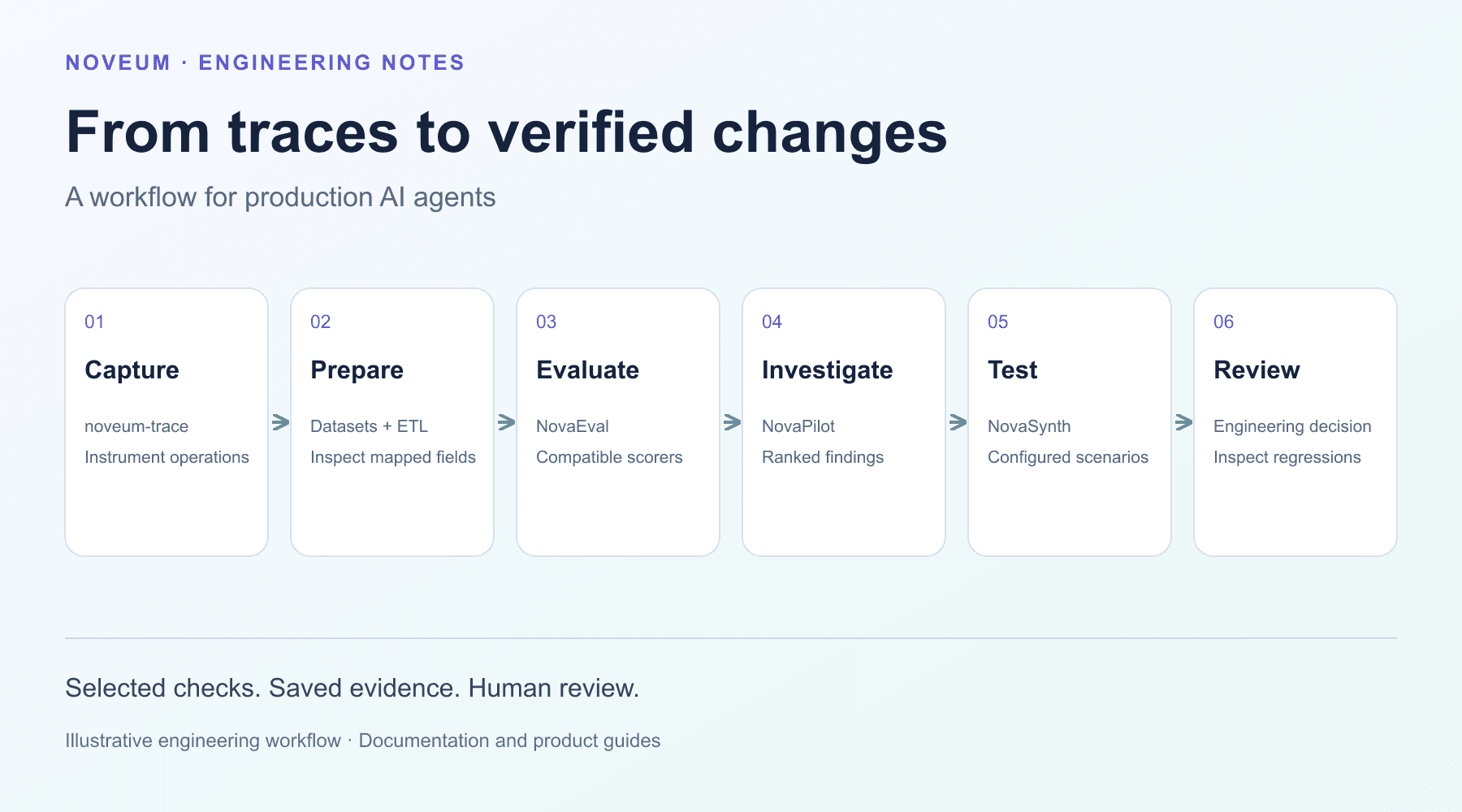
An average quality score can conceal the exact decision a release reviewer needs to make. An agent might produce a clear answer while taking an unsupported action. Another might complete the right task but fail a required output contract.
Quick answer: Keep task outcome, action permission, evidence quality and execution status separate. Apply explicit release rules to those dimensions before calculating a summary. If you publish an aggregate, retain its component results, weighting and denominator so a reviewer can reconstruct what it means.
Start with a release question
Consider an illustrative expense-routing assistant tested in a controlled environment. It must identify the right queue, preserve required approval and describe the observed result.
Suppose the output is readable and the routing destination is correct, but the assistant bypasses approval. A high average across style, routing and permission would obscure the reason to reject that run. This is a proposed fixture, not a Noveum customer incident.
Keep a decision table
| Dimension | Evidence | Example release treatment |
|---|---|---|
| Destination | Controlled queue state | Required task condition |
| Permission | Recorded approval and action order | Required boundary |
| Explanation | Final response versus observed state | Review material contradictions |
| Execution | Harness and integration status | Mark invalid or incomplete runs separately |
Choose the rules for the actual application. A permission requirement should not disappear inside a stylistic average.
Show the denominator
Report attempted cases, evaluable cases and excluded cases with reasons. A transport failure may prevent grading; it still matters operationally. Silently dropping those runs makes a summary difficult to interpret.
Preserve category results too. A change can improve routine routing while making ambiguous requests worse. That calls for a different decision from a uniform improvement.
Use a summary as an entry point
A dashboard can lead with a compact status while linking to components and failed cases. Reviewers should be able to answer what changed, which conditions failed and what evidence remains missing.
I'm Shashank Agarwal, founder and CEO of Noveum AI and creator of API.market. My recommendation is to make the release rule explicit before choosing an aggregate.
Use the acceptance-criteria guide to define required behavior and the evaluation workflow to connect results to iteration.
Follow my work on LinkedIn. Drafted with AI assistance.
Get Early Access to Noveum.ai Platform
Join the select group of AI teams optimizing their models with our data-driven platform. We're onboarding users in limited batches to ensure a premium experience.