
Organize Repeated Agent Failures Into an Engineering Task

Shashank Agarwal
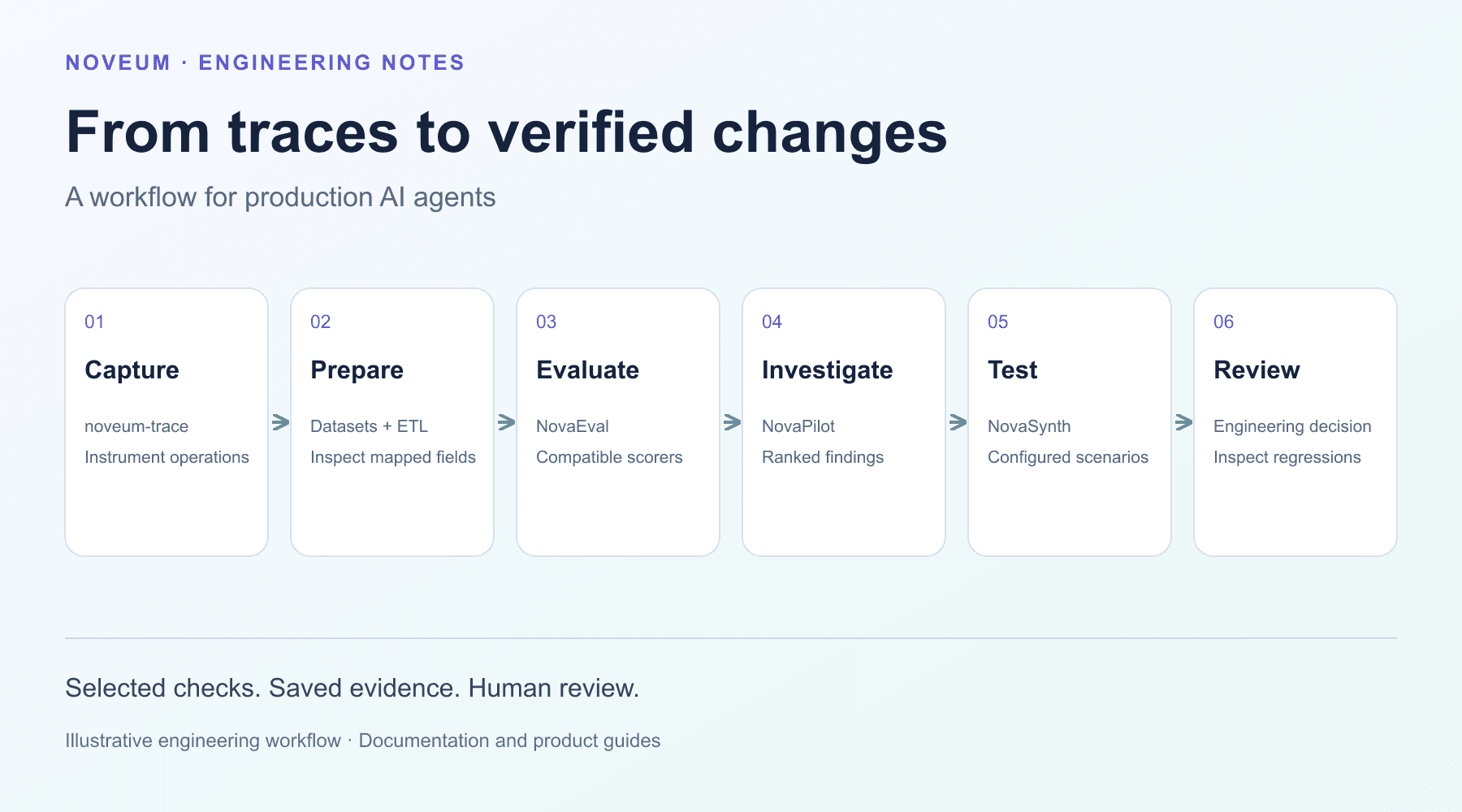
A list of failed traces is not yet an engineering task. Repeated wording can conceal different causes, while different-looking conversations can expose the same broken transition.
Quick answer: Group failures by the observable mismatch and relevant execution stage. Keep representative cases, exceptions and the selection method. Define a candidate task with an owner, proposed mechanism and acceptance checks, without treating the cluster label as a proven root cause.
Group by behavior before explanation
Imagine an illustrative fulfillment assistant with several wrong-location operations. Some runs received the wrong location from retrieval; others received the correct location but submitted different tool arguments.
A cluster called “location errors” is useful for discovery. It should split into distinct investigation tasks once the evidence identifies different transitions.
Build a small triage record
| Item | Purpose |
|---|---|
| Inclusion rule | Explains why cases belong together |
| Representative failures | Preserves the pattern's evidence |
| Nearby passing case | Helps identify what differs |
| Execution stage | Bounds the investigation |
| Missing evidence | Prevents premature attribution |
| Proposed next test | Makes the task actionable |
Do not infer production frequency from a hand-selected collection. Report how the cases were found and whether the sample is representative.
Preserve the exception
A case that looks similar but contradicts the proposed mechanism is valuable. It may expose a second failure type or show that the mechanism is too broad.
Retain the exception rather than deleting it to make the cluster tidy. A team can investigate several mechanisms without pretending that one fix will address every symptom.
Close against behavior
The task's acceptance conditions should inspect the relevant outcome on failing and nearby valid cases. A newly added log message alone does not establish that the agent chooses the right location.
These are proposed triage methods using synthetic examples. They describe how to organize evidence into work, not a claim that an automatic analysis system has already fixed an application.
I'm Shashank Agarwal, founder and CEO of Noveum AI and creator of API.market. These are proposed engineering methods and illustrative fixtures, not measured customer results.
Use the tool-boundary guide for operation evidence and the regression-test guide for controlled verification.
Follow my work on LinkedIn. Drafted with AI assistance.
Get Early Access to Noveum.ai Platform
Join the select group of AI teams optimizing their models with our data-driven platform. We're onboarding users in limited batches to ensure a premium experience.