
What to Keep From a Failed Voice Simulation

Shashank Agarwal
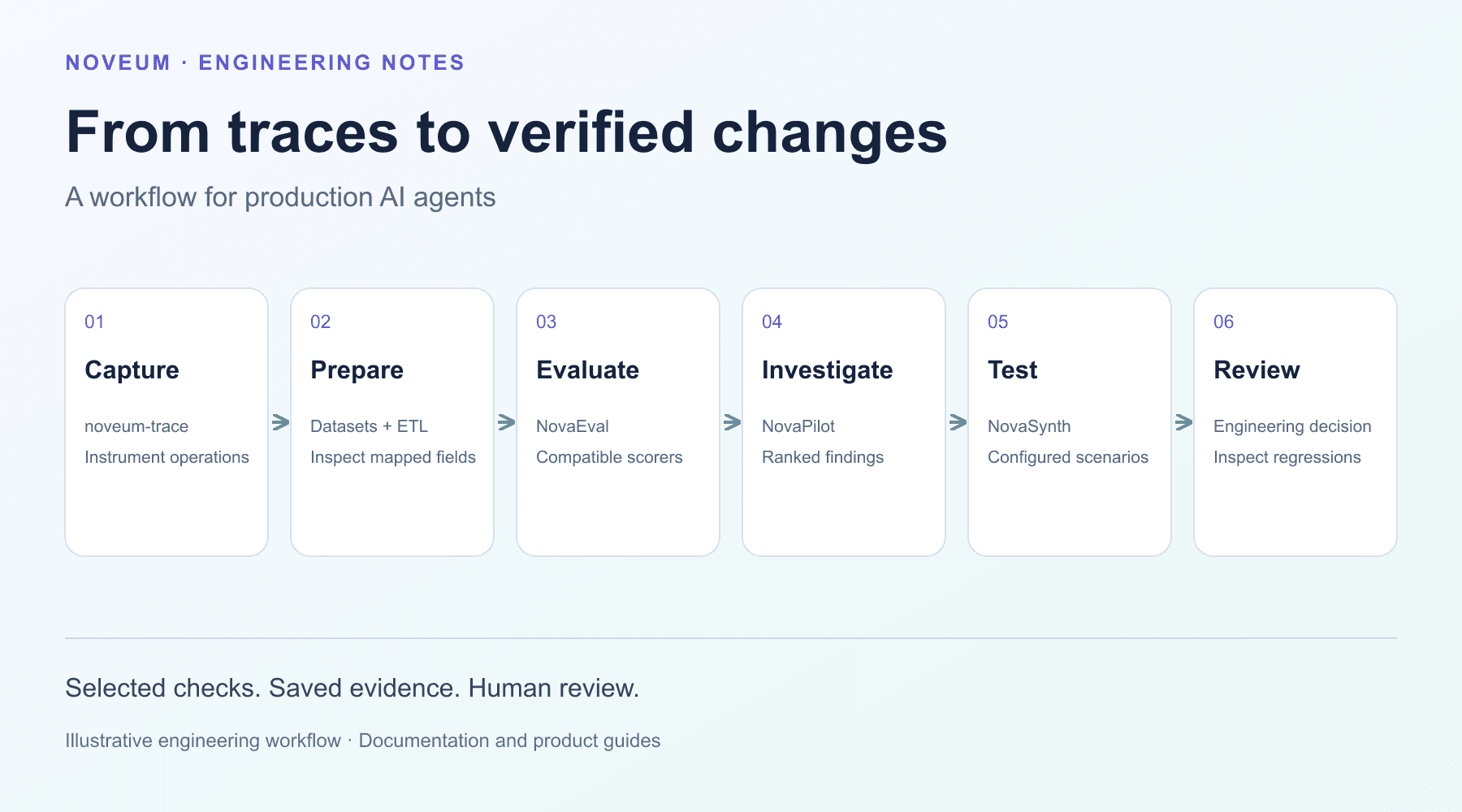
A failed voice run should leave enough evidence for another engineer to understand the task, locate the relevant event and test a candidate correction. A score and a transcript link are often only the beginning.
Quick answer: Keep the caller goal, scenario and agent configuration, relevant conversation evidence, available operation records and the expected-versus-observed mismatch together. Record transport or fixture failures separately. Minimize sensitive content and preserve missing evidence as a limit on the conclusion.
Write the mismatch in one sentence
For an illustrative appointment agent: “The caller corrected the requested day, but the proposed booking still used the earlier day.” This identifies an observable failure more clearly than “the agent misunderstood the conversation.”
Retain the relevant correction and proposed action. If no booking operation was captured, do not silently upgrade a spoken proposal into a confirmed state change.
Assemble a reviewable evidence packet
| Item | What the reviewer needs |
|---|---|
| Goal and starting state | The task and relevant controlled fixture |
| Configuration | Agent, prompt, caller and scenario versions |
| Relevant conversation | The segment containing the request and correction |
| Available audio or timing | Evidence needed for audibility or turn-handling questions |
| Operations and outcomes | What was proposed, attempted and established |
| Evaluation result | The actual check, explanation and saved decision |
| Open questions | Missing fields and competing explanations |
This is a proposed engineering packet, not a claim that a platform automatically captures every item.
Preserve the failed attempt
If a rerun passes, retain the original failure and the changed conditions. A passing retry can be useful evidence, but replacing the failed record hides variation and makes later review less reliable.
If the target never received the call, classify that execution problem separately from a conversation-quality result. If the simulator ignored its scenario, record that too.
Propose a bounded next test
For the corrected-day example, a candidate might explicitly update the task state after a caller correction. Test that case alongside a caller who never changes the day and a caller whose correction is ambiguous.
An effective investigation packet connects the result to that next decision. It should not imply that one explanation has been proven merely because it sounds plausible.
I’m Shashank Agarwal, founder and CEO of Noveum AI and creator of API.market. NovaSynth supports configured scenario testing; the team reviews the evidence and owns the candidate change.
See the tool-boundary guide for operation records and the repeatable-failure guide for controlled reproductions.
Follow my work on LinkedIn. Drafted with AI assistance.
Get Early Access to Noveum.ai Platform
Join the select group of AI teams optimizing their models with our data-driven platform. We're onboarding users in limited batches to ensure a premium experience.