
Why an Agent Trace Needs Configuration Versions

Shashank Agarwal
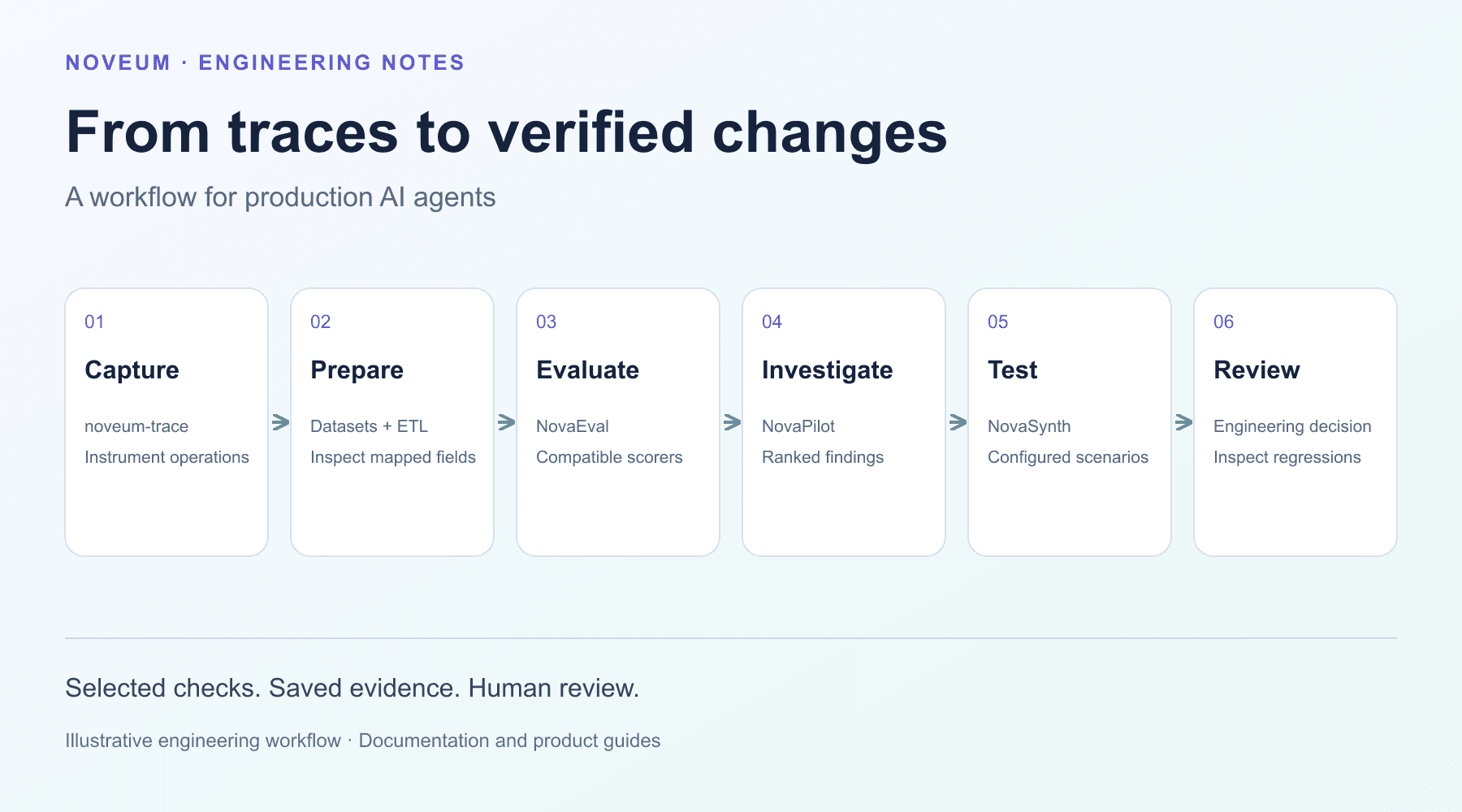
Two traces with the same input can belong to materially different systems. A model name alone may not explain which prompt, tool contract or source revision produced the result.
Quick answer: Record a stable agent release identifier and references to the relevant prompt, model configuration, tool contracts and retrieval configuration. Keep evaluation versions separately. Use identifiers that resolve to retained artifacts; a label that cannot be looked up is weak reproducibility evidence.
Make the release identifiable
Consider an illustrative document assistant whose answer changes after a deployment. The prompt stayed the same, but the source collection and context-selection rule changed.
If both runs carry only “production,” a reviewer has to reconstruct history from deployment notes. A release manifest can connect each trace to the configuration actually intended for that deployment.
Decide what belongs in the manifest
| Reference | Why it matters |
|---|---|
| Application release | Identifies workflow code |
| Prompt revision | Identifies task instructions |
| Model and parameters | Describes the configured generation |
| Tool contract revision | Explains available operations and response shapes |
| Source and retrieval configuration | Explains evidence selection |
| Evaluator revision | Explains how the result was judged |
This is a proposed manifest. Actual reproducibility also depends on provider behavior, external state and retained fixtures.
Preserve references without embedding secrets
Use a revision identifier or an appropriately protected artifact reference. Do not place API keys or complete private prompts into a public debugging note.
A hash can help identify an artifact, but it does not recover the artifact or establish that a runtime used it correctly. The deployment process and captured execution evidence still matter.
Compare changes deliberately
When several components changed together, describe the result as a comparison of configurations. Avoid attributing improvement to a single prompt edit without a suitable controlled test.
Before closing an investigation, confirm that the trace's recorded release agrees with the deployment being reviewed. A stale environment label can create false confidence in an otherwise detailed report.
I'm Shashank Agarwal, founder and CEO of Noveum AI and creator of API.market. These examples describe proposed engineering methods, not customer incidents or measured performance.
Use the tool-boundary guide to define operation evidence and the regression-test guide to preserve a controlled reproduction.
Follow my work on LinkedIn. Drafted with AI assistance.
Get Early Access to Noveum.ai Platform
Join the select group of AI teams optimizing their models with our data-driven platform. We're onboarding users in limited batches to ensure a premium experience.