
Where Human Judgment Belongs in Agent Evaluation

Shashank Agarwal
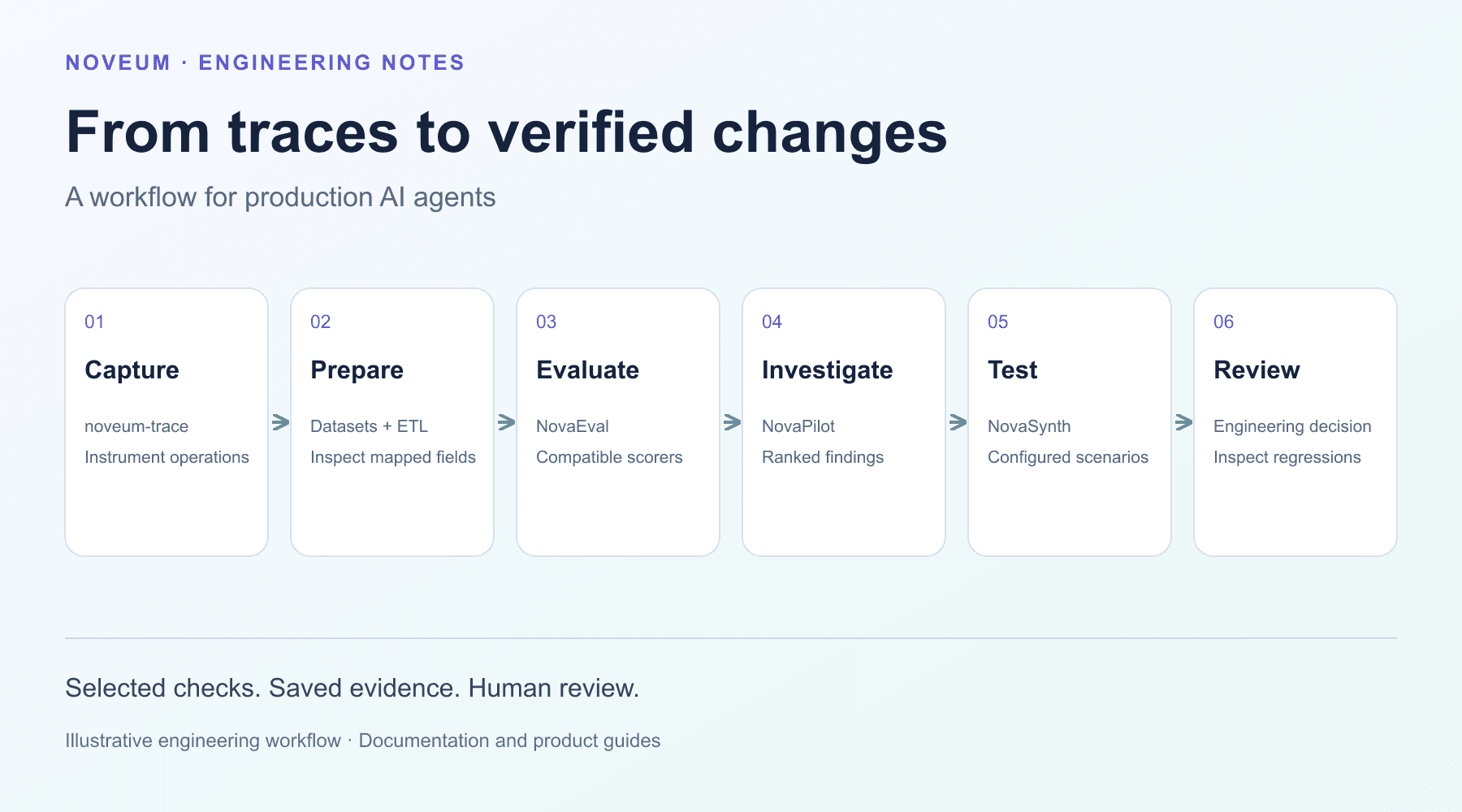
Human review works best when the reviewer has a defined question and the evidence needed to answer it. A request to “check whether the agent looks good” leaves too much room for inconsistent decisions.
Quick answer: Use human judgment to define acceptance conditions, resolve ambiguous cases, review grader disagreements and own release decisions. Give reviewers the task, relevant evidence and a versioned rubric. Preserve disagreements instead of silently replacing them with a single authoritative label.
Review a decision, not a whole transcript by default
Imagine an illustrative support assistant that offers an alternative after a requested item is unavailable. The reviewer needs to decide whether the alternative respects the stated requirements. They need the request, availability fixture and proposed alternative.
They may not need unrelated conversation history. Limiting the packet makes review more focused while reducing unnecessary exposure of sensitive content.
Give reviewers a shared packet
| Packet item | Purpose |
|---|---|
| User goal and constraints | Establish what success means |
| Relevant action and response evidence | Show what happened |
| Rubric version | Identify the decision rule |
| Allowed labels | Separate pass, fail and insufficient evidence |
| Explanation field | Record the decisive observation |
Have reviewers assess a few cases independently before reconciling their decisions. A disagreement may reveal an ambiguous requirement rather than a careless reviewer.
Separate correction from policy choice
If one reviewer missed an explicit location constraint, the evidence can resolve the dispute. If the task never defined whether a substitute is acceptable, the team needs to clarify product behavior.
Do not retroactively change the expected result merely because the candidate system produced a persuasive response. Save the old decision and document why the rule changed.
Connect review to the next run
A human finding should lead to a concrete action: revise an ambiguous criterion, add missing instrumentation, correct a reference or propose a candidate agent change. Re-run affected cases after that action.
I'm Shashank Agarwal, founder and CEO of Noveum AI and creator of API.market. I recommend treating review records as part of the evaluation system, with ownership and evidence.
The acceptance-criteria guide helps define the question; the regression-test guide connects a finding to a repeatable check.
Follow my work on LinkedIn. Drafted with AI assistance.
Get Early Access to Noveum.ai Platform
Join the select group of AI teams optimizing their models with our data-driven platform. We're onboarding users in limited batches to ensure a premium experience.