
How to Choose an AI Agent Evaluation Platform: A Buyer's Framework Backed by Real Benchmark Data

Shashank Agarwal
Somewhere in this week's production traffic, one of your agents asserted a number that appears in no document, called a tool with an argument it invented, or drifted out of its role over a long conversation. The question is not whether that happened. It's whether anything you run caught it before a user did.
That is the job of an AI agent evaluation platform: it is the referee for your production traffic, and its mistakes ship unsupervised. Most teams pick this referee without a benchmark. Every vendor claims the most accurate LLM-as-judge and the least noise, no claim has been tested against the others on the same data, and the buyer's guides that should close that gap don't measure anything.
This guide takes the opposite approach. Every criterion here is tied to a measured number from a reproducible benchmark of eight evaluation platforms on 440 production-style traces. By the end you'll have the six criteria that predict whether a platform holds up in production, the benchmark results in plain language, and a method to run the same comparison on your own traffic.
AI Agent Evaluation Platform Comparison Methodology by Noveum
The numbers in this guide come from one study: a benchmark of Noveum, Arize/Phoenix, Braintrust, DeepEval, Ragas, Galileo, Maxim, and Patronus, hosted platforms, open-source libraries, and one purpose-built hallucination model, compared on the same data for the first time.
The setup, in three sentences. We built a real retrieval-augmented (RAG) support agent, ran it through 100 adversarial multi-turn conversations, and collected 440 assistant turns, 131 of which contained genuine hallucinations. Each platform scored those turns with its own native scorers, in its strongest documented configuration, with no answer key, the same conditions it faces on your traffic. Ground truth was set by Claude Opus-4.8, a frontier model from a vendor none of the eight platforms use as a judge, so no platform graded its own work.
One caveat, stated plainly. Noveum built one of the eight platforms tested, and the agent under test answers questions about Noveum's own documentation, a home-domain advantage. The study reduces that advantage with third-party ground truth, best-configuration competitor setups, and a fully published dataset any reader can reproduce, but it does not eliminate it. Read the numbers with that in mind, and re-run the ones that matter to you.
The Six Dimensions Every AI Evaluation Platform Should Measure
A scorer is a specific evaluation method, usually an LLM-as-judge prompt, sometimes a purpose-built model, that reads a trace and returns a verdict on one quality dimension. Platforms ship dozens. Six dimensions cover what goes wrong in production, across three surfaces of agent behavior.
What the agent said (the RAG triad, the core RAG evaluation metrics for any retrieval-augmented agent):
- Faithfulness / hallucination detection: Is every concrete claim supported by the retrieved context? The anti-fabrication scorer, and the most important one for unsupervised evaluation, because a confident ungrounded answer is the most dangerous thing a RAG agent ships.
- Answer relevance: Did the response address what the user asked? A correct, on-topic decline counts; a marketing deflection doesn't.
- Context relevance: Did retrieval pull chunks relevant to the question? This scores the retrieval pipeline, not the generation. An empty retrieval is a real zero, not a non-result.
What the agent did:
- Tool-call correctness: Did it pick the right tool (selection), with real, non-fabricated arguments (parameters)? An agent that calls the right API with an invented project ID fails silently in a way text scorers never see.
How the agent behaved over a conversation:
- Role adherence: Across a full multi-turn thread, did it stay in its instructed role, including under pressure? A conversation-level property that single-turn scorers cannot measure.
And one property of the scorer itself:
- Judge quality: How well the scorer's verdicts agree with ground truth, measured by recall, false-alarm rate, and correlation for graded dimensions.
When a vendor says "we detect hallucinations," ask which of these six they cover natively. Coverage across all six is rare, and the gap list is also your requirements list: a tool-calling agent needs a tool-call scorer, a multi-turn agent needs a conversation-level scorer, or that failure surface goes unwatched.
False-Alarm Rate: The Metric Most AI Evaluation Platforms Don't Report
Recall, the share of real failures a scorer catches, is the number every vendor leads with. On its own it's close to meaningless: a scorer that flags everything has 100% recall and is useless.
The number that decides whether you can trust a platform to gate deployments without a human in the loop is the false-alarm rate: of the answers that were good, how many did the scorer wrongly flag? Every false alarm is a wrong verdict shipped unsupervised, a correct answer blocked, a clean trace sent for review, a working deploy held back.
 The benchmark makes the trade concrete. Ragas caught the most hallucinations of any platform, 94% recall, and wrongly flagged 37% of correct answers; at that calibration it cannot run an automatic quality gate, because more than a third of what it blocks is fine. Braintrust flagged only 8% of good answers, with Noveum at 10% and Arize at 11%. Ask every vendor for the false-alarm rate at the threshold you'd deploy at. If they only quote recall, that silence is your answer.
Why the Same AI Agent Evaluation Platform Can Produce Different Results
Two scorers inside the same platform, on the same data, can disagree so sharply they belong to different products. Braintrust's ClosedQA scorer flagged 8% of correct answers; its autoevals.ragas scorer flagged 66% of the same answers. DeepEval's GEval caught 73% of hallucinations; its FaithfulnessMetric caught 1%. All four are real, documented, shipped scorers.
A standard vendor demo proves little on its own, because the vendor picks the scorer. What you're choosing isn't "Braintrust" or "DeepEval" as a name; it's a specific scorer, in a specific configuration, on the kind of traffic you run. Any comparison that reports "Platform X scored Y" without naming the scorer and configuration isn't one you can act on. Get both, and test them on your traffic before you commit.
Six criteria for choosing an AI agent evaluation platform
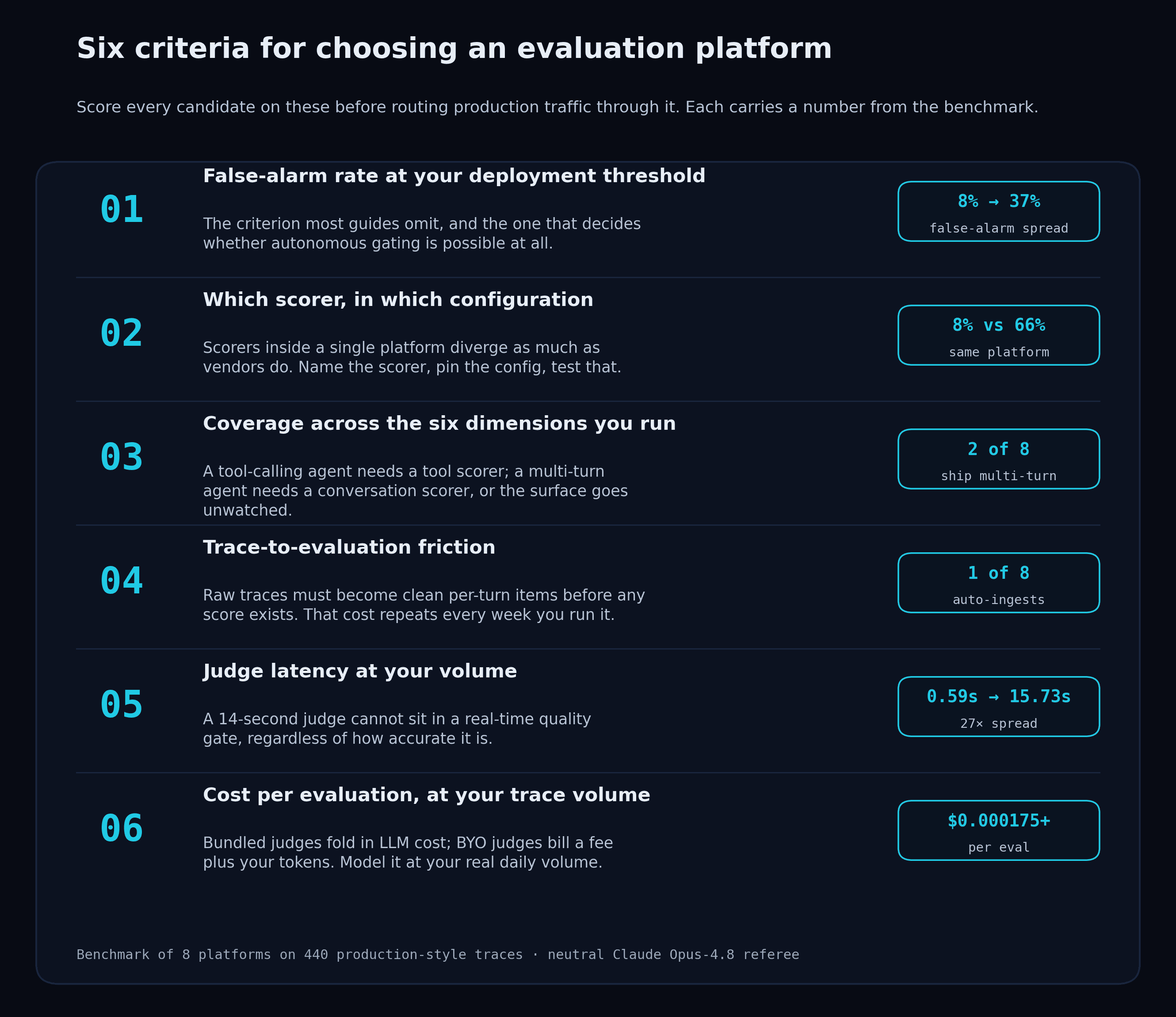
Score every candidate on these before routing production traffic through it. Each carries a number from the benchmark so it can't be waved away as opinion.
1. False-alarm rate at your deployment threshold. The criterion most guides omit, and the one that decides whether autonomous gating is possible at all. Benchmark spread: 8% to 37% on identical traffic.
2. Which scorer, in which configuration. Scorers inside one platform diverge as much as 8% versus 66% false alarms. Name the scorer, pin the config, test that.
3. Coverage across the six dimensions you run. Only two of the eight platforms, Noveum and DeepEval, ship a dedicated multi-turn role-adherence scorer; some ship no locally runnable tool-call scorer at all. If your agents speak, add audio scoring (mispronunciation, pipeline latency, speaking over the user) as a seventh criterion, since most text-first platforms can't score it.
4. Trace-to-evaluation friction. Raw traces have to become clean, per-turn evaluation items before any score exists. One platform in the benchmark did this automatically, no manual field mapping, producing 440 ready-to-score items on its own; the other hosted platforms require the operator to map fields, and the libraries require hand-built test cases. This cost repeats every week you run the platform, and it extends past ingestion into the workflow around evaluation: turning failures into test cases, gating deploys in CI, keeping the eval dataset current as prompts and models change.
5. Judge latency at your volume. Measured on the same judge-model call, latency ran from 0.59 seconds to 15.73 seconds, a 27x spread. A 14-second judge cannot sit in a real-time quality gate regardless of accuracy.
6. Cost per evaluation, at your trace volume. Bundled judges fold LLM cost into a per-eval charge; BYO judges bill a platform fee plus your own tokens. In the benchmark's verifiable pricing, Galileo's Luna small-model judge was cheapest at 0.00084 was lowest among the capable general judges. Where per-eval cost is opaque, treat it as unknown, not cheap, and model the bill at your real daily volume.
Open-source libraries vs hosted platforms: Which One Fits Your AI Evaluation Workflow?
One structural fork comes before any scorecard. Open-source libraries like DeepEval and Ragas are pip-installable, run on your own judge model, and fit naturally into CI/CD evaluation gates. The trade: they don't ingest production traces; you hand-build every test case and maintain the harness. Hosted platforms ingest traces and score continuously, which production AI monitoring requires, at the cost of a platform fee and usually some setup.
Many experienced teams run both, a library gating changes in CI and a hosted platform watching production. The real question isn't "library or platform." It's which layer each candidate is strong at, and whether the hosted platform you pick can take a raw trace without a week of plumbing.
What Noveum’s benchmarking reveal about AI Evaluation Platforms
 The full report runs deep: significance tests, Pareto frontiers, per-failure-family detection maps. Here's the version you can act on in an afternoon. It's close to the top of individual dimensions, and different platforms lead different jobs.
Ragas posted the highest context-relevance correlation (0.95, Noveum 0.945, DeepEval 0.92), a strong retrieval-quality scorer. Braintrust posted the lowest false-alarm rate (8%, ClosedQA), attractive for conservative gating. DeepEval tied for the top tool-selection score and is one of only two platforms with a true multi-turn scorer. Arize posted the best-balanced tool-parameter profile (100% recall, 81% specificity).
On hallucination detection, the top three on recall, Noveum 89%, Arize 82%, Braintrust 80%, are close enough that their confidence intervals overlap: a statistical tie, not a ranking. Patronus, a purpose-built hallucination model, caught 48%, handling blatant fabrications but missing the fluent, plausible ones that dominate real production failures.
On answer relevance, Noveum correlated at 0.78 while the rest landed between 0.04 and 0.27. This was the lowest-powered dimension in the study, so read it as the other scorers failing to separate good answers from bad ones here, not as one platform being several times better. On role adherence, every platform, including the leaders, scored the failing agent more leniently than the neutral reference did; calibrate before using conversational scores as gates.
One result worth carrying into your own testing: 78% of the agent's hallucinations came with no retrieval at all. The agent skipped the lookup and answered anyway. A faithfulness scorer has to treat an empty retrieval as a signal, not abstain, or it misses most of what goes wrong.
Benchmarking of eight leading AI Agent Platforms at a glance
| Platform | Type | Ingests raw traces? | Faithfulness (recall / false-alarm) | Multi-turn scorer? | Judge latency |
|---|---|---|---|---|---|
| Noveum | Hosted platform | Yes, automatic | 89% / 10% | Yes | 0.59s |
| Arize / Phoenix | Hosted + OSS runtime | Yes, with field mapping | 82% / 11% | No | 1.04s |
| Braintrust | Hosted platform | Yes, with field mapping | 80% / 8% | No | 3.30s |
| DeepEval | OSS library | No | 73% / 10% | Yes | 3.86s |
| Galileo | Hosted platform | Yes, with field mapping | 100% / 48%* | No | n/a |
| Maxim | Hosted platform | Yes, with field mapping | 99% / 48%* | No | n/a |
| Ragas | OSS library | No | 94% / 37% | No | 13.62s |
| Patronus | Eval API | No | 48% / 18% | No | 15.73s |
*Galileo and Maxim figures are from a separate 160-turn/e2e run; see the full report for methodology.
None of the eight was benchmarked on audio, since the agent under test is a text chatbot. If your agents speak, audio evaluation is a separate requirement most of this field can't meet. Full per-dimension results, significance tests, and methodology are in the complete benchmark report.
How to Evaluate AI Agent Evaluation Platforms on Your Own Production Traces
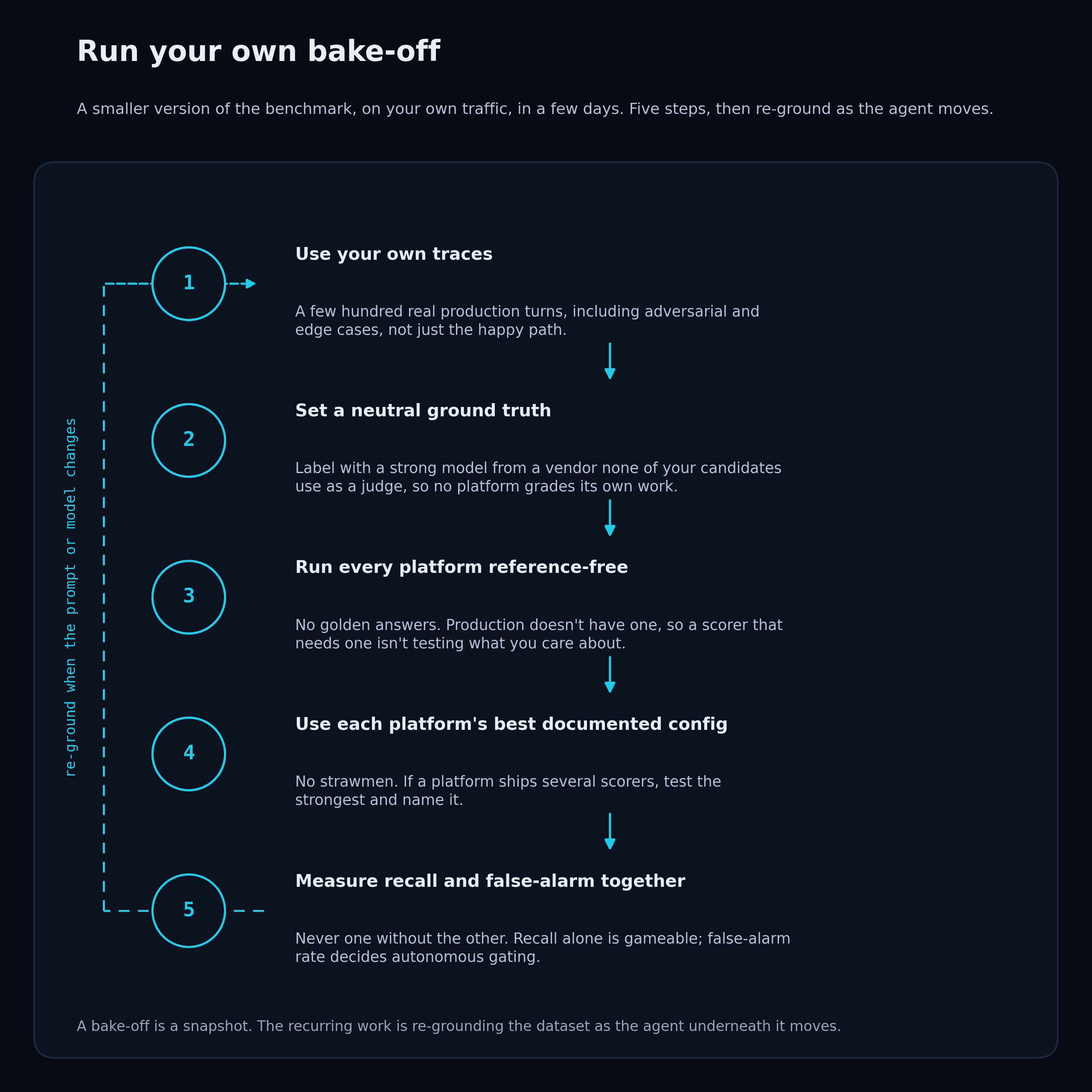
The fastest way to run this yourself: instrument your agent on Noveum's free plan, which auto-ingests your traces into scoreable items with no field mapping, then compare its verdicts against any other candidate on the same turns. The method behind it is public, so you don't have to trust our numbers, and a smaller version runs on your own traffic in a few days.
- Use your own traces. A few hundred real production turns, including adversarial and edge-case ones, not just the happy path.
- Set a neutral ground truth. A strong model from a vendor none of your candidates use as a judge, so no platform grades its own work.
- Run every platform reference-free. No golden answers. Production doesn't have one, so a scorer that needs one isn't testing the thing you care about.
- Run each platform in its best documented configuration. No strawmen. If a platform ships several scorers, test the strongest and name it.
- Measure recall and false-alarm rate together. Never one without the other.
Plan for one maintenance reality: your eval dataset drifts. Traces curated into a test set this week were generated by this week's prompt and model; ship a new prompt next month and that corpus no longer represents the system you run, and the new version's failure modes were never in it. A bake-off is a snapshot. The recurring work is re-grounding the dataset as the agent underneath it moves, which is why the workflow criteria above matter as much as the accuracy ones.
Which AI agent evaluation platform should you choose?
A buyer's guide that refuses to make a call isn't worth reading, so here's the call, with conditions attached.
If you need autonomous deployment gating, weight false-alarm rate first: Braintrust's ClosedQA (8%) and Noveum (10%) are the safest calibrations in the study, and a 37% false-alarm scorer is disqualifying for this job no matter its recall.
If you're library-first, gating in CI, DeepEval and Ragas are the right shape: pip-installable, BYO judge, strong on the dimensions they cover, with hand-built test cases and no trace ingestion as the trade.
If you run voice agents, most of this field doesn't apply, because text platforms can't score audio failures; evaluate audio coverage as its own requirement.
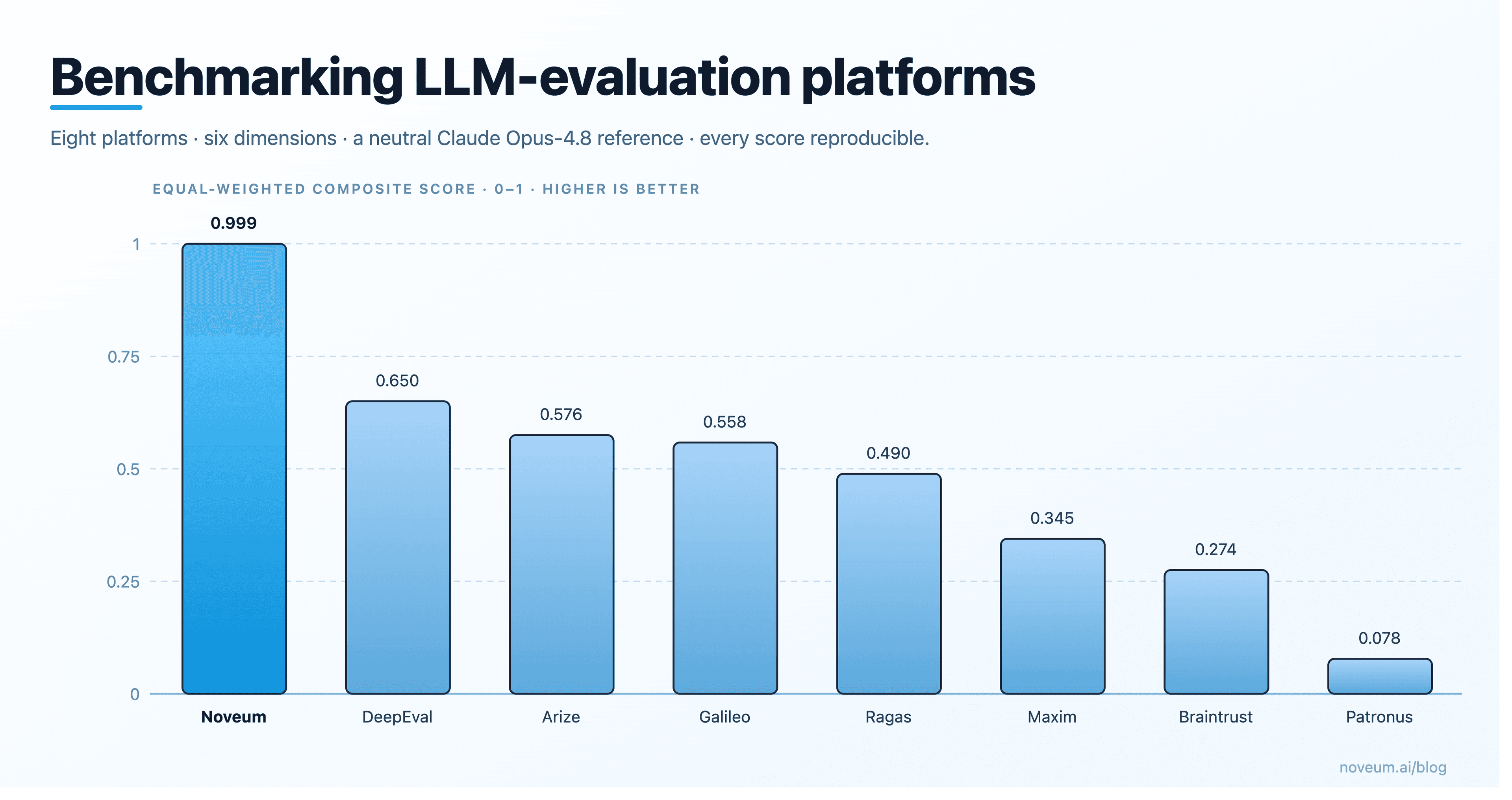
If you want one hosted platform strong across all six dimensions that takes raw traces without field mapping, Noveum topped the composite (0.999), was the only platform to auto-ingest traces, and ran the fastest judge (0.59s). The honest framing: its lead is breadth and balance, not dominance of any single number, and several individual dimensions are led by others.
Whatever you pick, pick it after the bake-off, on your own traffic. The point of this framework is that you never again have to take a vendor's word for it, including ours.
You have the six criteria, the benchmark results, and a method to reproduce both on your own traffic. Read the complete benchmark report for full per-dimension leaderboards and methodology, run your own agent's traces on Noveum's free plan. Book a call with Aditi to set up the bake-off on your production traces in about fifteen minutes
Frequently asked questions
What is the most important metric when choosing an AI evaluation platform? False-alarm rate at the threshold you'd deploy at, paired with recall. Recall alone is gameable; a scorer that flags everything has perfect recall and is useless. A platform is only safe for autonomous gating if it catches failures and leaves correct answers alone. Benchmark false-alarm rate ranged from 8% to 37% on identical traffic.
Why do two scorers on the same platform give different results? A scorer is a specific prompt and method, not a property of the platform. Braintrust's ClosedQA flagged 8% of good answers while its autoevals.ragas scorer flagged 66%; DeepEval's GEval caught 73% of hallucinations against 1% for FaithfulnessMetric. Always test the specific scorer and configuration you intend to run.
Should I use an open-source library or a hosted evaluation platform? They solve different problems. Libraries like DeepEval and Ragas are strong for CI gating, run on your own judge, and require hand-built test cases with no trace ingestion. Hosted platforms ingest production traces and score continuously. Many teams run a library in CI and a hosted platform in production.
How do I evaluate a platform without an answer key? Run it reference-free, the way production works. Label a sample of your own traces with a strong neutral model none of your candidates use, keep that label hidden from every platform, and measure how well each platform's scores agree with it. A scorer that needs a golden answer isn't testing the production case.
What is the difference between AI tracing tools and AI evaluation tools? Tracing tools record what your agent did: every LLM call, retrieval, and tool call, as spans you can inspect. Evaluation tools score whether what it did was good: faithfulness, relevance, tool correctness, role adherence. Some products do only one; some do both. If you want agents to improve over time, you need both, plus a path from a failed score back to the trace that produced it.
Does judge latency matter in practice? For real-time gates and high-volume scoring, yes. Benchmark judge latency ranged from 0.59 to 15.73 seconds on the same judge-model call. A 14-second judge can't sit in a real-time path. Confirm whether a vendor's quoted latency is the judge call or a full hosted round-trip, then time it on your own traffic.
Can I reproduce the benchmark myself? Yes. The agent, traces, reference labels, every scorer configuration, and the raw per-platform scores are published, so any figure can be re-derived and re-run on a different judge model, domain, or platform.
Get Early Access to Noveum.ai Platform
Join the select group of AI teams optimizing their models with our data-driven platform. We're onboarding users in limited batches to ensure a premium experience.