
Best Braintrust Alternatives for Teams That Need Production Fixing, Not Just Eval Methodology

Harkirat Singh
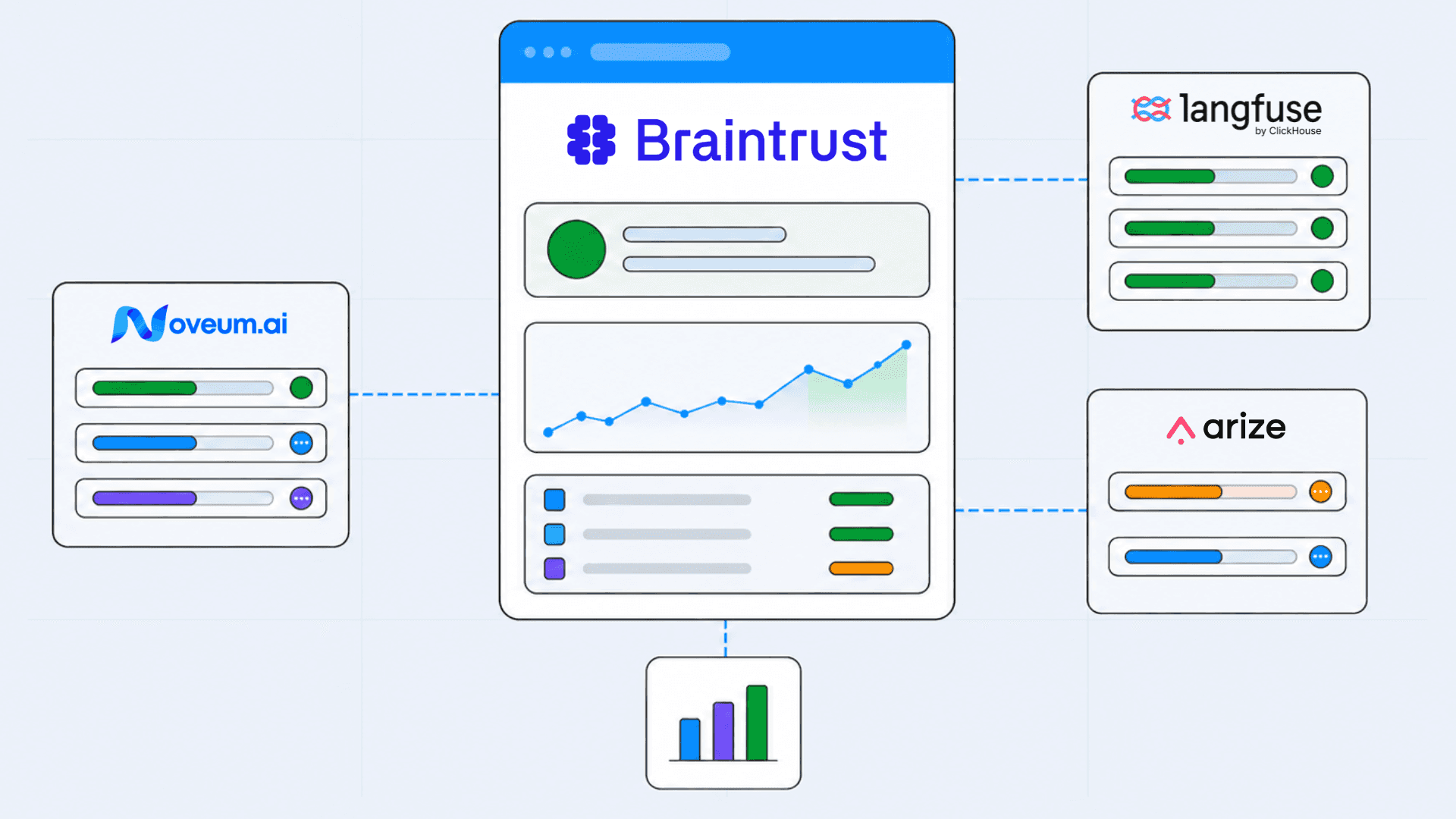
We've run evals, watched a score drop, and then done what most teams do next. We opened the trace, read it ourselves, rewrote the prompt by hand, and tested it again.
That loop is familiar to anyone running agents in production. It's also exactly what got us thinking harder about what an eval platform should actually be responsible for.
Braintrust is not the problem here. It built a genuinely solid eval and CI/CD workflow, and we'll give it full credit for that further down.
But evaluating a failure and fixing a failure are two separate jobs. Most of the market, Braintrust included, only does the first one well.
This guide walks through the Braintrust alternatives worth knowing in 2026, starting with the one we built specifically to close that gap, then covering the rest of the field as honestly as we can.
Here are the best Braintrust alternatives we're going to dive into, one by one:
- Noveum
- Confident AI
- Langfuse
- Arize
- Galileo
How we're evaluating these alternatives
Before ranking anything, here's exactly what we're judging each platform against, so you can weigh this yourself instead of taking our word for it:
- Production fixing. When an eval catches a real failure, does the platform identify the root cause and deliver a tested fix, or does it stop at the alert?
- Evaluation depth. How many scorer categories come out of the box, and how much do you have to build yourself?
- Voice and audio support. Does the platform evaluate spoken agents, not just text, things like mispronunciation, TTS quality, pipeline latency, talking over the user?
- Setup time. Minutes, days, or months to get real evaluation running on production traffic? Deployment and compliance. On-prem or VPC options, SOC 2, HIPAA, GDPR, for teams that can't send data to a generic SaaS.
We're leaving pricing out of this comparison on purpose. Plans and tiers change often enough that they go stale fast, and they tend to distract from the question that actually matters, which is whether the platform fixes what it finds.
The order below reflects how each platform performs against the criteria above, not company size or popularity.
We start with our own product because, on the specific question of production fixing, it's the only one here that does it at all, and we think that's worth being upfront about rather than burying.
1. Noveum, the only one that fixes what it finds
We built Noveum around a simple idea, analyze first, then fix, then improve, not just observe and alert. The figures below are our own published numbers, drawn from our product documentation and our head-to-head comparisons against Langfuse and Arize.
We're flagging that plainly, these are our claims about our own product, not numbers an outside auditor has signed off on, because we'd rather you know that than assume otherwise.
Key features
- Nova Eval, 100+ specialized scorers across 18 evaluation categories, running in real time: hallucination detection, faithfulness and grounding, tool correctness, RAG pipeline quality, safety and bias, role consistency, and more, plus custom scorers built from your own product requirements instead of generic templates.
- NovaPilot, the part most of this list doesn't have. When a failure is detected, it analyzes the failure pattern, tests multiple prompt variations across 4 evolutionary generations, and delivers a verified fix as a recommendation or an auto-generated pull request.
- Dedicated voice and audio scorers, covering TTS quality, voice pipeline latency, mispronunciation detection, speaking-over-user detection, and audio breakage, integrated with LiveKit, Twilio, and custom voice pipelines.
- A 15-minute live integration call to get real evaluation running, plus true on-prem deployment in your own VPC with bring-your-own ClickHouse, SOC 2 Type II, HIPAA, and GDPR support.
Why do teams use Noveum?
Teams come to us after they've already tried tracing and scoring on their own and hit the same wall. The eval tells them something is broken, and then an engineer spends the rest of the afternoon rewriting a prompt by trial and error.
We built NovaPilot to take that afternoon down to minutes. In our published flagship case, a cloud communication platform running 100+ voice agents went from a flagged failure to a verified fix in 10 minutes, after a 4-line integration, with a reported 4 to 6x performance improvement and a 95%+ success rate, up from a typical 20 to 30% baseline for unmonitored agents.
Voice is another reason teams pick us. If your agent talks, mispronounces a name, interrupts a customer, or has a laggy pipeline, a text-only evaluation tool will never catch those issues because it never listens to the conversation.
That's why we built dedicated voice scorers for Mispronunciation, Latency, Instruction Adherence, Average Pitch, and more. As far as we've seen, no other platform on this list offers this level of voice-specific evaluation.
Braintrust does have Loop, an AI assistant that suggests prompt improvements inside the platform. That's real, and a technical reader will know it. But the workflow Loop describes is: it proposes a change, you apply it, you rerun the eval, and you check the scores. A suggestion handed to a human is still a suggestion.
What NovaPilot ships is different in kind. It backtests the fix per-call against the actual failure trace, simulates it end-to-end, and delivers a verified PR autonomously.
The fix arrives already confirmed against the failure that triggered it. And it does this for voice agents too, where Braintrust has no audio scorers at all. If your agent mispronounces a name or talks over a customer, there is nothing for Loop to analyze. You cannot suggest your way out of a failure you never measured.
2. Confident AI
Confident AI is the AI quality platform built for enterprise teams to standardize evals and observability across the organization. Platform teams define one consistent quality and security standard, while different product teams use it to evaluate AI applications before launch and monitor them continuously in production.
Key features
- Research-backed metrics for agents, multi-turn applications, RAG, and safety
- Full tracing with online evaluations and signals on production traffic
- Synthetic dataset generation and multi-turn simulations
- Native red teaming and AI governance across pre-deployment and production
Why teams use Confident AI
Teams choose Confident AI when they need more than an evaluation workflow for one application. It gives platform teams a consistent standard that can be applied across different product teams, models, frameworks, and use cases.
The honest truth is that evaluation depth is strong here, but Confident AI stops at scoring and alerting. There's no automated fix-generation step, and no voice or audio evaluation.
3. Langfuse
Langfuse is the platform most teams already know, even if they've never run it themselves. It's the default answer whenever someone asks for an open-source way to trace LLM calls, and it's earned that reputation honestly over a few years of steady adoption.
We see it most often as the first tool a team reaches for, before they realize tracing and evaluation are two different problems.
Key features
- Fully open source (MIT), self-hostable, including air-gapped deployments
- Production tracing, prompt versioning, and cost tracking, considered the most widely deployed open-source tracing layer in this category.
- A large integration ecosystem, since it's been around long enough that most frameworks support it out of the box.
Why teams use Langfuse
Teams pick Langfuse when self-hosting and open source aren't negotiable, full stop.
It's free to run, the data never leaves your infrastructure unless you choose otherwise, and the tracing UI is mature.
What it doesn't do, per our own published comparison, is automated evaluation, auto-remediation, voice pipeline evaluation, or enterprise-ready custom scorers. Teams that adopt it are usually signing up to build their own eval layer on top, by hand.
The honest truth is that Langfuse tells you what happened. It doesn't tell you whether it was good, and it never tells you how to make it better.
4. Arize / Arize Phoenix
Arize comes from a different lineage than the rest of this list, classic ML monitoring rather than LLM-native tooling, and it shows in how the product is built.
Teams running both traditional models and LLM agents side by side tend to find it familiar in a way newer platforms aren't. The tradeoff is that LLM evaluation feels bolted on rather than built in from the start.
Key features
- ML-monitoring heritage and enterprise-scale infrastructure, with a free open-source layer in Phoenix.
- Agent workflow visualization across 20+ frameworks.
- On-prem and VPC deployment options, with enterprise SSO/SAML support.
Why teams use Arize
Teams that already run heterogeneous ML monitoring, classic models alongside LLM agents, tend to gravitate here, because it lets them watch both in one place.
Per our own published comparison, Arize's automated evaluation is limited, partially requires ground-truth labels, and has no auto-remediation engine, no voice or audio pipeline evaluation, and no white-label multi-tenant support.
The honest truth is that evaluation is positioned as secondary to Arize's core monitoring product, not a first-class capability. Like most of this list, a flagged failure still needs a human to read the trace, write the fix, and verify it by hand.
5. Galileo
Galileo takes the most different approach of anyone on this list. Rather than just scoring after the fact, it tries to catch and stop bad outputs as they happen, before they ever reach a user.
That real-time instinct is genuinely useful, and it's the one capability on this list that gets closest to feeling proactive instead of purely reactive.
Key features
- Galileo Protect, runtime guardrails that can block or transform an unsafe output before it reaches a user.
- Luna-2 small language models, claimed sub-200ms eval latency at a fraction of standard LLM-as-judge cost.
- Agent Graph, which visualizes every branch, decision, and tool call across a multi-agent workflow.
- Insights, which automatically clusters failure patterns instead of leaving you to scrub logs by hand.
Why teams use Galileo
Teams pick Galileo when their top priority is stopping a bad output in the moment, before a user ever sees it. Runtime blocking is a real, useful capability, and Galileo is the closest thing to it on this list.
The honest truth is that Protect is interception, not repair. Blocking a hallucination prevents the immediate harm, but the prompt or agent logic that caused it is untouched, so the same failure tends to come back on the next similar request until someone fixes the root cause by hand. We didn't find any source for voice or audio evaluation on Galileo either.
Best Braintrust alternatives in 2026
We'll say this plainly. Braintrust built one of the cleanest eval-to-CI/CD loops we've seen. A production trace becomes a test case in one click, that test case runs in a dataset experiment, and the score change posts as a comment on your pull request, with the option to block a merge on regression.
But Braintrust's own article on AI observability describes the manual gap that exists across the industry honestly:_ "Engineers still need to export logs, recreate the scenario, wire up an evaluation, and then remember to check whether the fix actually improved behavior. That work often gets deferred or skipped entirely"_ . Braintrust's answer to that is Loop suggesting a fix inside the platform. You still apply it, rerun it, and verify it yourself.
Every other platform we covered shares some version of the same gap. Langfuse hands you raw traces and leaves the rest to your engineers.
Confident AI standardizes how different teams evaluate, monitor, secure, and govern AI applications, but it does not automatically generate and verify the underlying fix. Arize watches and alerts. Galileo gets closest by blocking a bad output in the moment, but blocking isn't fixed, the broken prompt is still broken the next time a similar request comes in.
Five platforms, five ways of telling you something is wrong, and not one of them, Braintrust included, closes the loop by generating and verifying the fix itself.
That's where we think the comparison stops being close. We built NovaPilot because we kept watching teams hit the exact wall this article opened with, an eval catches something real, and a person loses an afternoon to manual trial and error.
NovaPilot turns that afternoon into minutes, testing multiple prompt variations across 4 evolutionary generations and handing back a fix already verified against the failure. In our published flagship case, that loop ran end to end in 10 minutes.
Layer the voice and audio scorers on top, and the gap widens further. None of the other five platforms in this guide listen to a call at all, so an entire category of real failures, a mispronounced name, a pipeline delay, an agent talking over a customer, simply doesn't exist for them. It exists for us, and we built a fix loop for it just like we did for text.
So if your only complaint about Braintrust is wanting regression tests in GitHub, you probably don't need to switch.
But if you're spending real engineering hours turning eval scores into fixes by hand, or any part of your stack talks instead of types, we think Noveum is the clear answer, not because we're the newest name on this list, but because we're the only one that finishes the job the rest of this category starts.
FAQ
Q1. Does Braintrust automatically fix production failures?
No. Braintrust scores outputs, traces production calls, and lets you convert failures into regression tests for CI/CD. Writing and verifying the actual fix is still a manual engineering task (Source: braintrust.dev).
Q2. What's the main difference between Braintrust and Noveum?
Braintrust evaluates and flags. Noveum evaluates, then NovaPilot tests 136+ prompt variations across 4 generations and delivers a verified fix, as a recommendation or an auto-generated pull request.
Q3. Which Braintrust alternative is best for voice agents?
Noveum is the only platform in this comparison with dedicated voice and audio scorers, covering TTS quality, mispronunciation, pipeline latency, and speaking-over-user detection.
Q4. How do we make sure our agent isn't hallucinating after we switch models?
Run Nova Eval's faithfulness and hallucination scorers against your production traces in real time, and let NovaPilot test and verify a fix automatically the moment a regression is detected. We offer a free tier and a free trial, no credit card required, with your first trace running in about 15 minutes.
_Considering Braintrust alternatives that close the loop on production fixing? Try Noveum. Book a 15-minute live setup call or sign up free, no credit card required. _
Get Early Access to Noveum.ai Platform
Join the select group of AI teams optimizing their models with our data-driven platform. We're onboarding users in limited batches to ensure a premium experience.