
TR

Observability

See every decision your agents make.

NovaTrace captures every LLM call, tool invocation, retrieval, and agent step — with tokens, cost, and latency attached. One SDK, deep framework integrations, and a transport layer that never takes your app down.

6M+

traces ingested per day

15,000

spans/sec, load-tested

15 min

from install to first trace

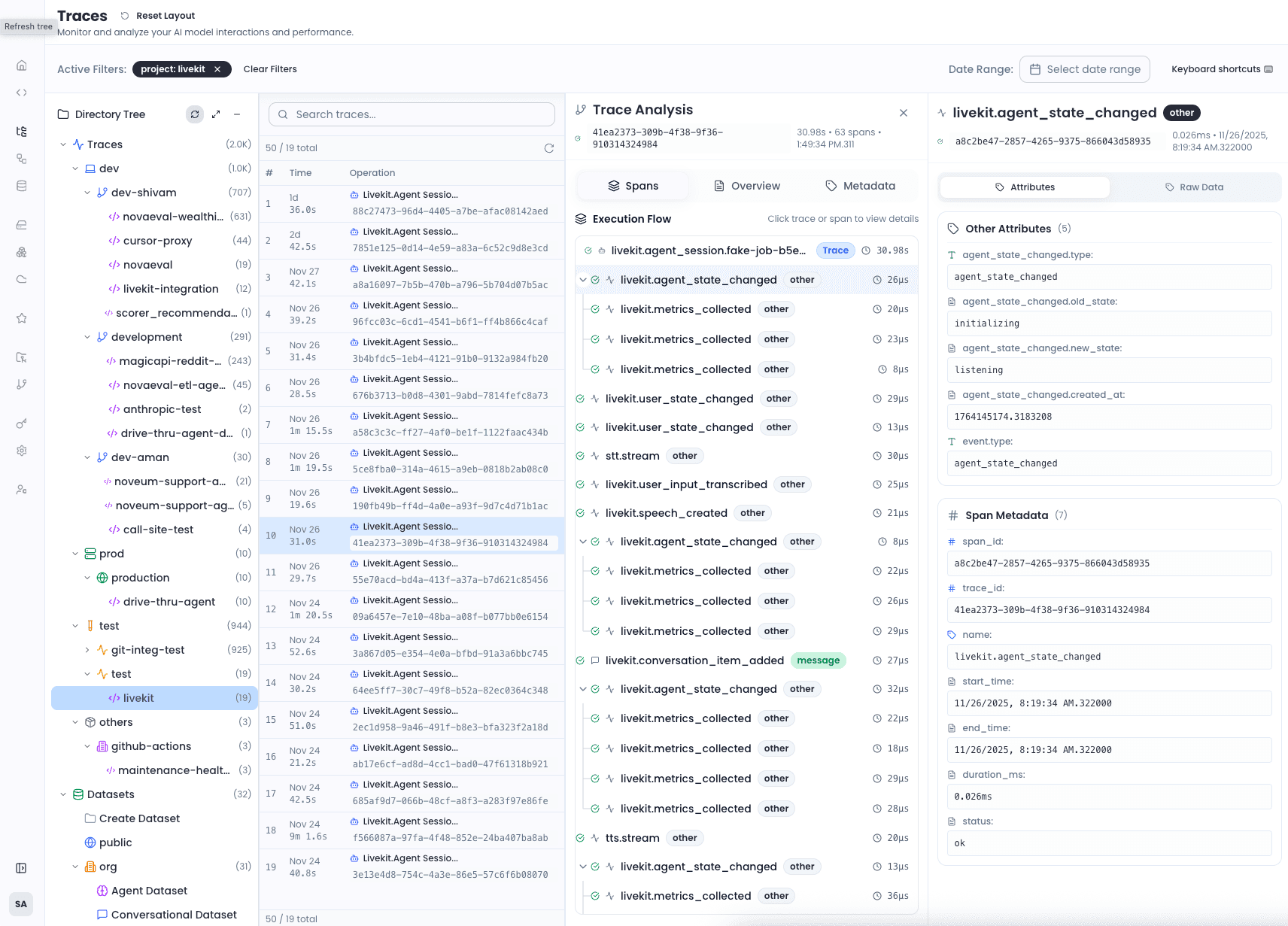
app.noveum.ai — traces explorer
The Noveum three-pane traces explorer

01 — Capabilities

Observability built for agents, not retrofitted.

Deep framework integrations

LangChain, LangGraph, LiveKit, Pipecat, CrewAI, LlamaIndex, AutoGen, and OpenTelemetry — real instrumentation, not thin wrappers. The LangChain callback alone covers LLM, chain, agent, tool, and retrieval events.

Cost & tokens at capture time

An embedded registry spanning 40+ models across 11 providers prices every call as it happens — input, output, and total tokens plus cost on each span — so cost-per-trace and cost-per-customer are queryable from day one.

Threads & multi-agent graphs

Conversation threads, agent registries, and workflow graphs keep multi-agent systems legible — who did what, in which order, and why.

Multimodal artifacts

Audio and image artifacts upload alongside spans — the raw material that voice and vision evals need.

Fail-soft transport

Batched, retried, sampled, and silent on failure. Tracing never takes your application down — a guarantee, not a goal.

OpenTelemetry-aligned

Traces, spans, attributes, and events that map cleanly onto OTel concepts, with a purpose-built wire format for LLM workloads.

02 — Integration

Live in fifteen minutes.

One init call plus the integration for your stack — and our engineers do it with you on the kickoff call.

pip install noveum-trace
from noveum_trace.integrations.langchain import (
NoveumTraceCallbackHandler,
)
handler = NoveumTraceCallbackHandler()
agent.invoke(
{"input": question},
config={"callbacks": [handler]},
)

What gets captured

  • Spans for every LLM, tool, retrieval & agent step
  • Token counts, model, cost, and latency per span
  • Conversation threads and multi-agent graphs
  • Audio & image artifacts linked to their spans

Python 3.9–3.13 · OpenTelemetry-aligned · MCP server included

03 — Under the hood

The specifics behind the SDK.

A columnar trace store, open-source SDKs, an embedded cost registry, and an MCP server — the concrete pieces that make agent observability queryable.

Storage engine

A ClickHouse columnar backend purpose-built for trace volume — faster aggregations and materially lower storage cost than Elasticsearch on the same workload.

Open-source SDKs

Python `noveum-trace` (3.9–3.13) and TypeScript `@noveum/trace` — instrument with decorators and context managers, one init call to start streaming spans.

Model & cost registry

An embedded registry covering 40+ models across 11 providers — OpenAI (gpt-4o, o1, o3, gpt-5), Anthropic Claude 3/3.5/4.5, Google Gemini 1.5/2.0/2.5, Cohere, Mistral, Meta Llama, DeepSeek, xAI Grok, Perplexity, Amazon Bedrock, and AI21.

Per-span economics

Input, output, and total token counts plus computed cost are attached to every span as it’s captured — cost-per-trace and cost-per-customer are queryable from day one, no post-processing.

Native integrations

First-class instrumentation for LangChain, LangGraph, LiveKit, Pipecat, CrewAI, LlamaIndex, AutoGen, and OpenTelemetry — real callbacks, not thin wrappers.

MCP server

An MCP server with ~80 tools, generated from the OpenAPI spec, exposes traces, spans, and metrics to your own agents — query and act on observability data in-loop.

The loop

Part of one closed loop.

Everything downstream — evals, simulations, guardrails, fixes — runs on the traces NovaTrace captures. It’s step one for a reason.

Next step

Put your production AI under control.

Start free and ship your first trace in 15 minutes — or book 30 minutes and we’ll integrate live on the call: your stack, your data, your first eval report before it ends.

SOC 2 Type II · HIPAA · GDPR · On-prem & BYO ClickHouse available